Before dawn on a spring morning, a charter flight lifts off from Kingston, or Bridgetown, or Port of Spain, carrying farm workers north to plant and tend and harvest the food that Canadians will eat without ever wondering who grew it. Months later, the same workers fly home. This annual migration, unglamorous and largely invisible, is one of the oldest and most concrete threads of the entire Canada–Caribbean relationship, a tie made not of treaties or summits but of hands in the soil.
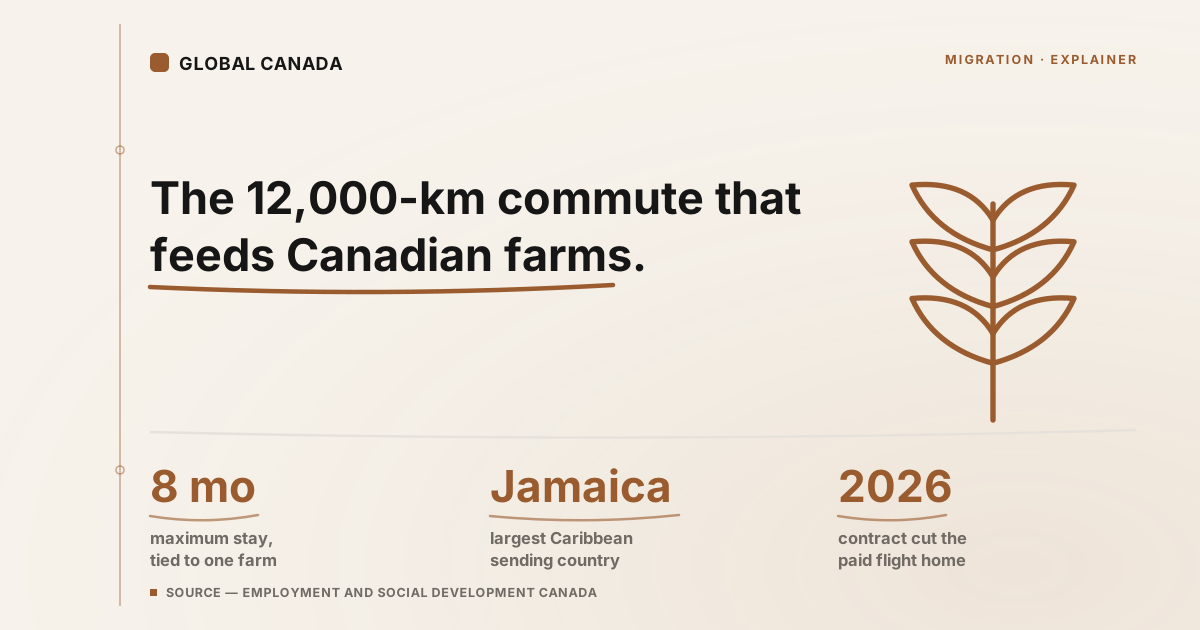
The mechanism is the Seasonal Agricultural Worker Program, a bilateral arrangement between Canada and a handful of partner countries: Mexico and, in the Caribbean, Jamaica, Trinidad and Tobago, Barbados and the states of the Eastern Caribbean. Jamaica sends the largest Caribbean contingent. Workers can be employed for up to eight months between January and December, tied to a specific employer, doing the seasonal work that Canadian agriculture has come to depend on and that, by and large, Canadians themselves will not do.
A genuine benefit, honestly weighed
It would be wrong to tell this only as a story of exploitation, because for many workers the programme is a real opportunity, and they return to it year after year by choice. The wages, modest by Canadian standards, are transformative by Caribbean ones, and the money sent home builds houses, pays school fees and sustains communities across the region. For the sending countries, it is a valuable source of remittances and a relief valve for unemployment. For Canadian farmers, it is the difference between a viable operation and unharvested fields. On its own terms, it works.
But the terms are where the relationship gets negotiated, and they are weighted. A worker’s permit is tied to a single employer, which means the freedom to leave a bad situation (the ordinary worker’s ultimate leverage) is sharply curtailed. Housing, health access and working conditions depend heavily on the goodwill of an individual farm. And the details that govern all of this are set not by the workers but for them, revised each year in a contract most Canadians will never read.
What the 2026 fine print reveals
That contract is worth reading, because it is where power shows itself. The 2026 amendments to the Caribbean agreement adjusted the permitted deductions from workers’ pay, capping the daily meal deduction at 11.73 dollars, nudging up a small weekly recognition payment. They added protections, too: a requirement that employers provide hotel accommodation and meals during long travel layovers, and, tellingly, a new clause specifying that workers’ private lives on their days off must be respected, a line that exists only because that respect could not previously be assumed.
And then there is the change that cuts the other way. Under the revised terms, a worker who chooses to leave the programme voluntarily is no longer guaranteed a paid flight home. It is a small clause with a large meaning: it raises the cost of walking away, and for a worker already bound to one employer, a cheaper exit was one of the few forms of leverage left. Advocates read it as a quiet tightening of an already unequal arrangement; the government frames it as a reasonable allocation of costs. Both readings can be true, which is precisely what makes the fine print worth watching.
The honest verdict on the Seasonal Agricultural Worker Program is that it is neither the scandal its harshest critics describe nor the win-win its defenders claim. It is a genuinely valuable exchange conducted on genuinely unequal terms, a relationship in which both sides gain, but one side writes the contract. It is also, for all that, among the most durable and human ties Canada has to the Caribbean: hundreds of thousands of individual working lives, stitched across an ocean, one growing season at a time. The planes will take off again next spring. The question worth asking is who the next contract is written for.