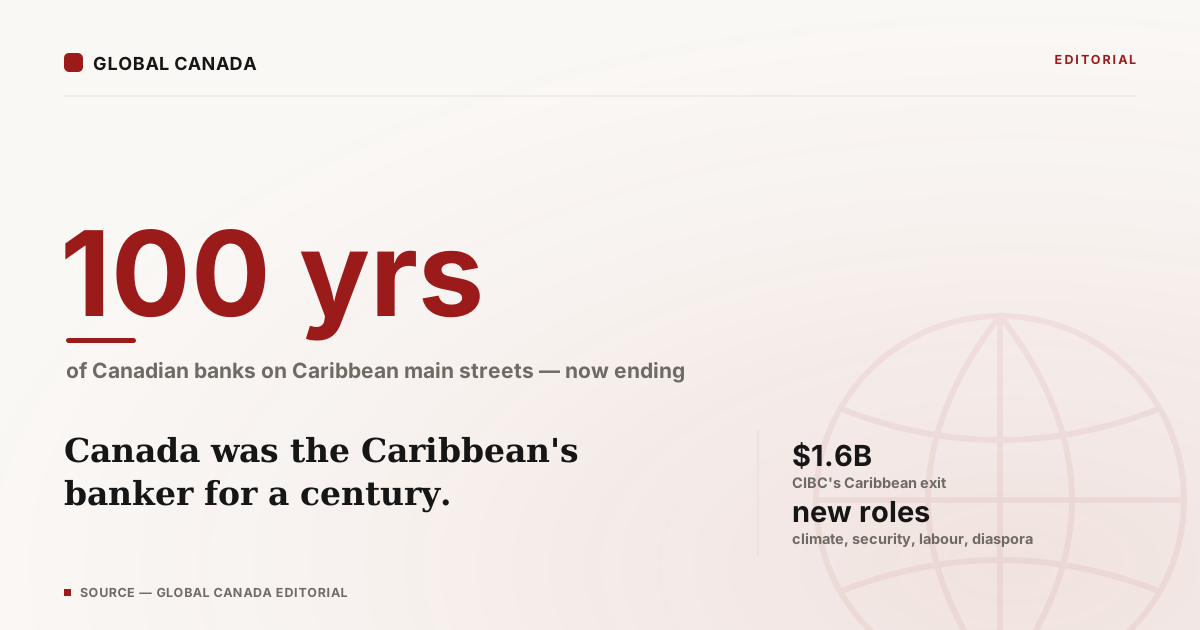
For the better part of a hundred years, if you walked down the main street of a Caribbean capital, you would pass a Canadian bank. Scotiabank, CIBC, Royal Bank, their signs were as much a part of the streetscape as the churches and the rum shops, and behind them stood a quiet fact of regional life: Canada was the Caribbean’s banker. It took the deposits, made the loans, financed the trade, and in doing so wove itself into the daily economy of the islands more intimately than any aid program ever could.
That era is ending. In 2026 CIBC agreed to sell its Caribbean operations for around 1.6 billion US dollars, and Scotiabank has been steadily unwinding its own regional footprint, folding units and retreating toward the North American market where the profits are richer. The math is unsentimental, in early 2026 the Caribbean contributed barely a tenth of Scotiabank’s earnings against North America’s four-fifths, but the meaning is larger than the balance sheet. A century-old institutional presence is being packed up, and the region is left with a question it has not had to ask in generations: who is the Caribbean’s banker now?
The strange thing is that even as Canada withdraws in this one, oldest form, it is arriving in half a dozen new ones. The relationship is not shrinking. It is being rewritten, all at once, and in almost every register but the one it used to run on.
Where the banks are leaving, climate finance is coming in. Ottawa has put money behind an unusual set of instruments to keep small island states solvent against rising seas, a contribution to a resilience facility, a first-loss credit guarantee run through the Caribbean Development Bank, a blended-finance climate fund built to pull private money in behind public dollars. It is development by financial engineering rather than aid cheque, and it reflects a hard truth these islands keep pressing at international meetings: they are too rich, on paper, to qualify for the cheapest financing, and too exposed, in reality, to survive without it.
Where the relationship was once soft, it is turning, in one corner, hard. In Haiti, Canada has become one of the largest funders of an armed international force fighting the gangs that have seized much of the country, more than 126 million dollars and a seat at the table of the partners overseeing the mission. A relationship built on development assistance has acquired a security edge it did not have before, and with it all the old, unresolved questions about foreign intervention in a country that has seen too much of it.
Where it is most concrete, it is also most contested. Every year thousands of Jamaican, Trinidadian and Barbadian workers fly north to plant and pick Canada’s crops under a seasonal programme that is among the oldest and most tangible strands of the whole relationship, and whose fine print, revised again for 2026, is where the real balance of power between a Canadian farm and a Caribbean worker gets quietly negotiated.
And where it is newest, it is booming in a way no one planned for. Guyana, long among the poorest corners of South America, struck oil and became the fastest-growing economy on earth, and it is tied to Canada by a diaspora of roughly a hundred thousand, concentrated in the suburbs of Toronto, now watching a homeland transform. The most dynamic node in Canada’s Caribbean relationship turns out to be one almost no strategy document anticipated.
If there is a through-line in all of this, it is that the Canada–Caribbean relationship is being renegotiated on every front simultaneously, and that the terms are not settled. The withdrawal of the banks is a real loss, and it would be a mistake to let the flurry of new initiatives paper over it. But it would be a bigger mistake to read the bank exits as the whole story. Underneath them, the relationship is arguably denser than it has been in decades: more instruments, more money, more people moving in both directions, just organized around climate, security, labour and diaspora rather than around a branch on the corner.
There is one more thread that binds it, and it runs, characteristically, through people rather than governments. Every August, Toronto stages the largest Caribbean carnival in North America: two million people, half a billion dollars, a city remade in feathers and soca. Caribana is the most visible face of a Caribbean-Canadian community that has spent generations turning migration into culture and culture into a two-way channel of money, music and belonging. It is a reminder that whatever the banks and the ministries do, the deepest tie between Canada and the Caribbean was never really financial. It was human.
The relationship is in the middle of reinventing itself, shedding the role it played for a century and trying on several new ones at once. The banks are coming down off the main streets. What Canada becomes to the region in their place is still, very much, being decided.