Somewhere in Kathmandu, a nurse who has already spent years in training and on the wards sits down to an exam written for a health system on the far side of the planet. Passing it could change the shape of her life — and the lives of the family whose futures she is quietly carrying. The exam is the NCLEX, the licensing test most Canadian provinces require, and for a growing number of Nepali nurses it has become the narrow gate through which a career abroad must pass.
It is easy to tell this story as a matter of supply and demand: one country short of nurses, another with more than its own hospitals can employ, and a queue forming between them. But that framing flattens something more complicated. The nurse at the exam table is not a unit of labour to be sourced. She is a person weighing an opportunity against everything she would leave behind — and the truth is that both countries with a claim on her genuinely need her.
The pull, and the gauntlet
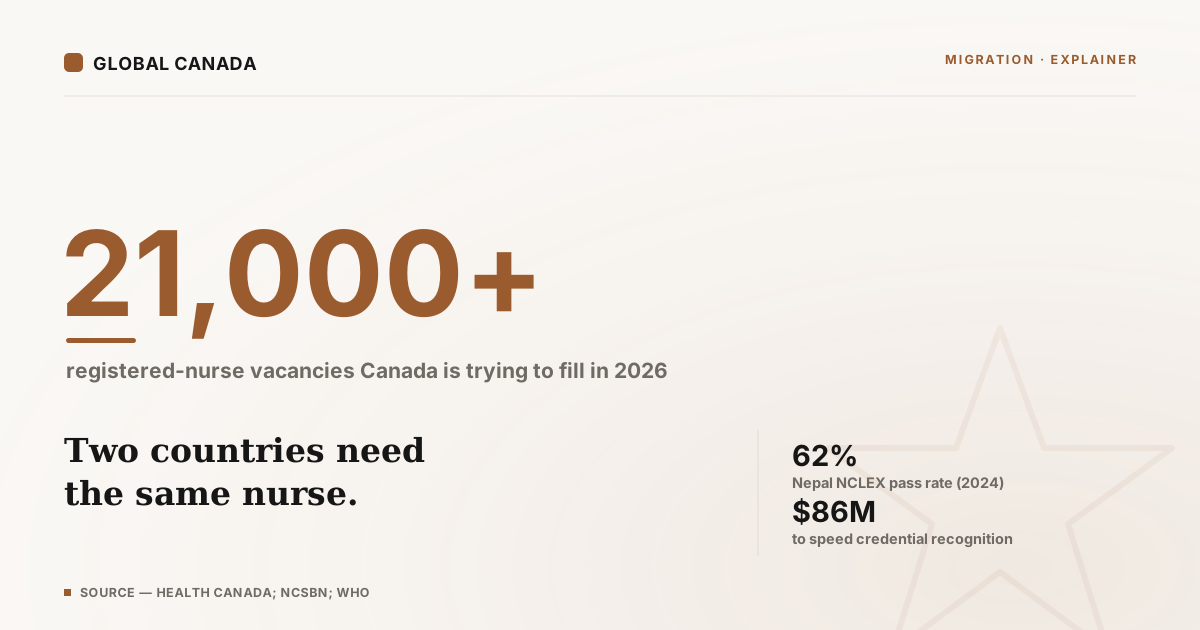
The pull from Canada is real and large. The country faces more than 21,000 registered-nurse vacancies in 2026, and an ageing population, exhausted staff and years of under-training have left it structurally short of exactly the people it needs most. For a qualified nurse abroad, that shortage is an open door.
Getting through it, though, is less a walk than an obstacle course. A nurse trained in Nepal must first have her credentials assessed, then reviewed by the National Nursing Assessment Service — a process that runs three to six months and costs somewhere between 650 and 850 Canadian dollars before any other fee. Then comes the NCLEX-RN, then language testing, then provincial registration. Each step carries a cost, a wait and a chance of failure. On 2024 data, nurses educated in Nepal passed the NCLEX at about 62 percent, below the rates for several other source countries — less a reflection on the nurses than on the distance between how they were trained and what a foreign exam expects. Either way, the effect is concrete: many who set out never reach the ward, having spent months and savings to be stopped at the gate.
The question the brochures skip
Here is the part a blunt telling leaves out. Nepal needs these nurses too.
A country does not train a nurse for free, and Nepal — with its own rural clinics understaffed and its own health system stretched — is not a bottomless well of surplus caregivers. When a wealthy country recruits health workers from a poorer one, it is, in plain terms, drawing on training the poorer country paid for to fill gaps in the richer one. That is precisely the transfer the World Health Organization’s code on the international recruitment of health personnel exists to make governments think twice about. None of which is an argument against the individual nurse’s choice: her right to move, to earn, to build a life is hers, and the money she sends home is a real and immediate good for her family and her country. But it is an argument for honesty about the ledger, and for the things that tip it toward fairness — ethical recruitment that does not strip source countries in crisis, support so that those who do come actually make it through the gate rather than being quietly filtered out by it, and investment and knowledge that flow back the other way.
A bridge worth building carefully
Step back and a pattern comes into view. As Canada’s student cap has choked the education channel that long defined the Canada–Nepal relationship, the care economy is emerging as its successor — a more regulated, potentially more durable form of the same human tie. Ottawa has begun, tentatively, to ease the path, investing up to 86 million dollars across fifteen organizations to speed the recognition of foreign credentials for thousands of internationally educated health professionals. The bottleneck is understood; whether the money clears it is another matter.
Done well, this is genuinely mutual: the nurse builds a career, a Canadian ward gets staffed, and Nepal gains remittances now and, over time, returning expertise and lasting links between the two health systems. Done carelessly — recruiting hard when short-staffed, shrugging at what the source country loses, letting the credentialing maze do the quiet work of exclusion — it curdles into something closer to extraction. The difference is not in the flow of nurses. It is in whether Canada treats them as a stopgap to be drawn down or as people, and a partnership, to be tended.
For now the exams go on, in testing centres in Kathmandu and Canadian cities alike, each one a small negotiation between a nurse’s ambition, a family’s hopes, and two countries that both, for their own reasons, need her to say yes.