The defence-industrial relationship between Canada and Japan produced two verdicts within a few weeks of each other in the summer of 2026, and they pointed in opposite directions. One was a win Canada could hardly have scripted better. The other was a door quietly closing. Read together, they tell you more about what a “strategic partnership” can and cannot deliver than any communiqué.
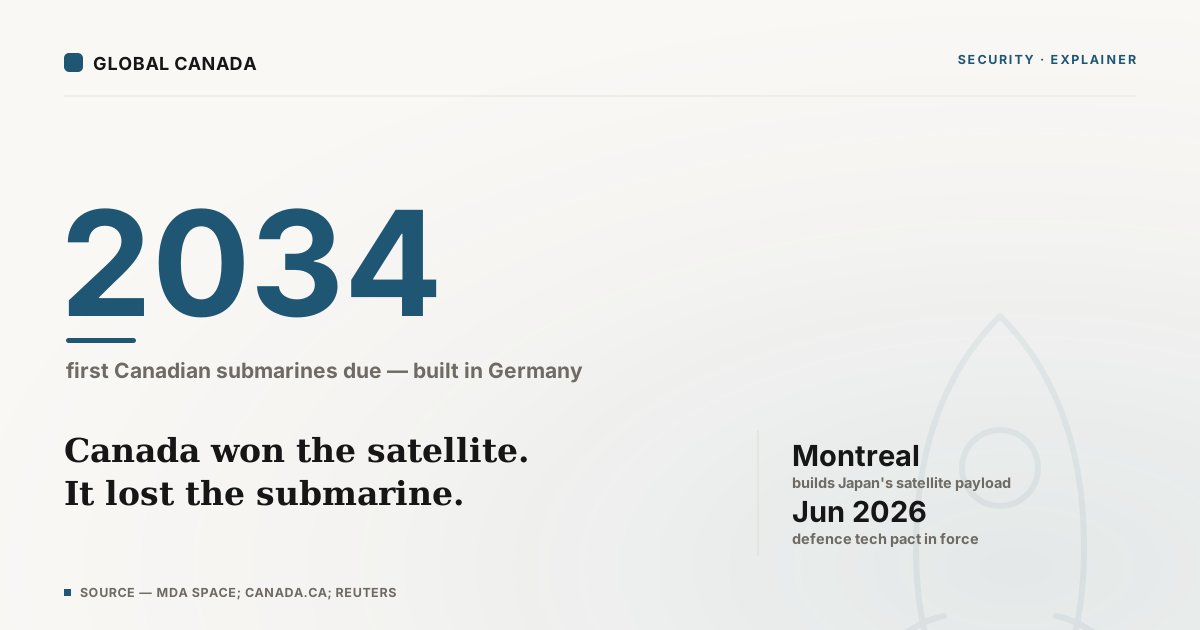
Start with the win. Mitsubishi Electric selected a Canadian company, MDA Space, to build the payload — the working heart — of Japan’s next-generation defence communications satellite, with the manufacturing and testing done in Montreal. It is a marquee result: a Japanese defence program reaching across the Pacific to put a critical piece of its military space capability in Canadian hands. For a country that has spent fifty years excelling at space hardware, it is exactly the kind of high-value, high-trust work the new partnership was supposed to generate.
The agreement that made it possible
None of it would have been legal a year earlier. The enabling instrument is the Defence Equipment and Technology Transfer Agreement, which entered into force on the sixteenth of June 2026 and allows the two countries to co-develop, buy, sell and export advanced defence equipment and the intellectual property behind it. Around the same time, Canada’s defence minister, David McGuinty, led a defence trade mission to Tokyo and met his counterpart, Shinjiro Koizumi, to talk about widening the industrial relationship into aerospace, critical minerals and advanced technology.
This is the machinery of a serious defence partnership being assembled in real time — the legal plumbing, the ministerial visits, the first concrete contract. A satellite payload built in Montreal for a Japanese military program is not symbolism. It is a supply-chain integration that would have been unthinkable a decade ago.
The door that closed
And then, the submarine. In the same season, Canada was choosing a builder for the Canadian Patrol Submarine Project — at a scale that makes it the largest defence procurement in the country’s history, a multi-decade program to replace an ageing fleet. Japan builds excellent conventional submarines and had been discussed as a possible contender. It chose not to bid.
On the sixth of July 2026, Canada named Germany’s ThyssenKrupp Marine Systems its preferred supplier, with the first boats due in 2034. Japan was simply not in the room. There are sound reasons a country might decline such a contest — the terms, the timelines, the domestic industrial politics of exporting submarines — and Japan’s absence is not a snub. But it is a fact, and it sits awkwardly against the language of ever-closer partnership.
Reading the two verdicts together
Here is the honest lesson. A strategic partnership is not a merger. Two countries can build each other’s satellites and still buy their submarines elsewhere, because each major decision gets made on its own cold merits — the best payload, the best boat, the best price and terms — and no amount of shared framing overrides that when the stakes are high enough.
That is not a failure of the partnership. It is the shape of the thing. The satellite shows how far Canada–Japan defence cooperation can now reach: real, sensitive, high-value work flowing across the Pacific under a brand-new legal framework. The submarine shows the ceiling: on the biggest calls, both countries remain sovereign buyers shopping the whole world, and Germany can still beat Tokyo for a Canadian contract.
For a relationship this young, that is a healthy balance to strike — ambition and realism in the same season. The payload will be built in Montreal. The submarines will be built in Germany. And the partnership will be judged, in the end, not by the deals it wins or loses in any given month but by whether the trust that let a Japanese military satellite be entrusted to a Canadian firm keeps deepening once the ceremonies are over.