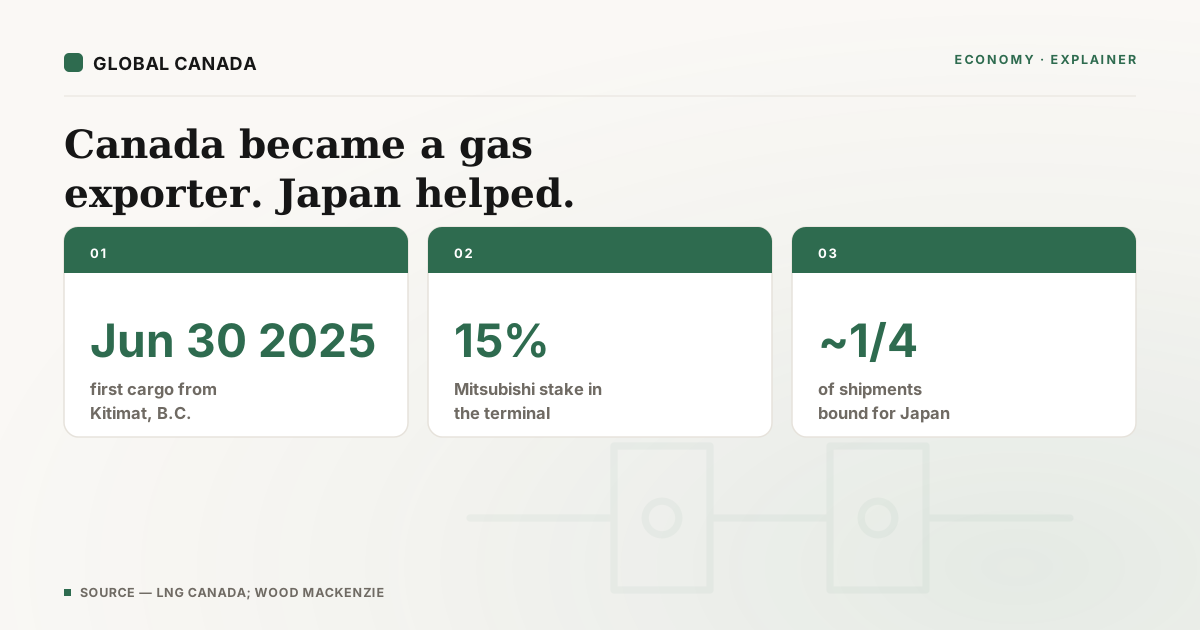
For decades Canada watched the liquefied-natural-gas boom happen to other countries. It had the gas (vast reserves in the northeast of British Columbia and Alberta) and none of the coastline infrastructure to sell it to the places that wanted it most, all of which sat across the Pacific. Then, on the thirtieth of June 2025, a tanker took on the first cargo at a new terminal in Kitimat, and a country that had exported almost no LNG suddenly had a dock, a market and a place in a trade it had missed for a generation.
The terminal is called LNG Canada, and its ownership list reads like a map of who wanted Canadian gas badly enough to pay for the plumbing. Shell holds the largest share. Malaysia’s Petronas, PetroChina and South Korea’s Kogas are in. And so, with a 15 percent stake, is Mitsubishi, one of Japan’s great trading houses, Japanese capital literally embedded in the concrete of a British Columbia export terminal.
The Japan connection, made physical
The stake is not sentimental. Japan is one of the world’s largest importers of LNG, an industrial economy on a chain of islands with almost no fossil fuel of its own, perpetually exposed to the question of where the next winter’s energy will come from. For Tokyo, a new supplier on the far side of the Pacific (in a stable democracy, reachable without passing through any of the world’s dangerous chokepoints) is worth owning a piece of.
The gas has followed the money. Japan takes roughly a quarter of LNG Canada’s shipments; by the middle of March 2026 more than a dozen cargoes had already been delivered there. The plant’s first phase is designed to produce 14 million tonnes a year across two processing trains, and it has been ramping toward full output, projected to approach two billion cubic feet a day by late 2026.
The timing turned out to be remarkable. Just as Canadian gas began to flow, a supply shock in the Middle East rattled the global LNG market and sent buyers hunting for suppliers they could count on. Canada arrived at exactly the moment reliability became the scarcest commodity in energy, a stable source that does not require a tanker to thread the Strait of Hormuz. A project conceived years earlier, for ordinary commercial reasons, found itself with sudden strategic value.
What it is, and what it isn’t
Be clear about the nature of the win. This is Canadian energy diversification made real, the first serious crack in the country’s near-total dependence on selling its hydrocarbons south to the United States. For years the complaint about Canadian energy was that it had exactly one customer. Kitimat is the beginning of an answer.
But it is a beginning, not an arrival. A single terminal, even a large one, does not remake an energy relationship. And there is a genuine tension worth naming: LNG is a fossil fuel, and a country with ambitious climate targets is now in the business of shipping more of it across the Pacific. Ottawa’s answer (that Canadian gas displaces dirtier coal in Asian power plants) is plausible and also convenient, and the honest accounting of whether it holds depends on details that are easy to assert and hard to verify.
There is also the familiar dependency question, inverted. Japan gains a reliable supplier; what does Canada gain besides a buyer? A customer is not the same as leverage, and a terminal part-owned by foreign firms sending gas abroad is a normal commercial arrangement, not a geopolitical masterstroke. The value is real but modest: one more market, one less bet riding on a single customer, one Japanese trading house now materially invested in Canada’s success.
The tanker that left Kitimat in the summer of 2025 was carrying more than gas. It was carrying the first evidence that Canada could sell its energy to someone other than its neighbour, and that Japan, reading the same unsettled world Ottawa is reading, was willing to help build the dock to make sure it could.