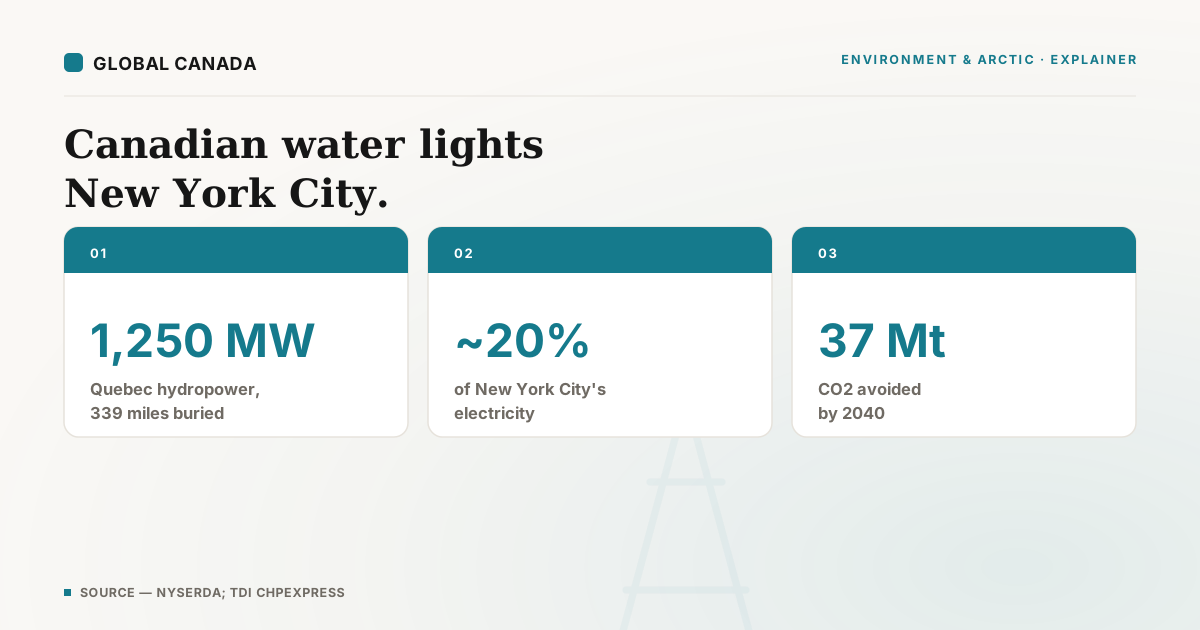
For most of its 339 miles the newest piece of critical infrastructure in the northeastern United States is invisible. It runs under the bed of Lake Champlain, then down the Hudson River, then beneath roads and rail beds, a pair of cables no wider than a dinner plate, until it surfaces in a converter station in Astoria, Queens. On the first of June it was switched on. It now carries up to 1,250 megawatts of electricity south from the Quebec border, and almost none of it was generated by burning anything.
The Champlain Hudson Power Express is the kind of project that never makes a front page and quietly rearranges a region. It links the vast hydroelectric reservoirs of northern Quebec directly to the grid of New York City, delivering an expected 10.4 terawatt-hours of clean power a year. That is close to a fifth of the city’s electricity. More than a million homes. Enough, by the developer’s accounting, to keep 37 million tonnes of carbon dioxide out of the atmosphere by 2040. Governor Hochul’s office called it a blueprint. Stripped of the ceremony, it is Canadian water helping keep the lights on in Manhattan.
An old trade, finally wired
Canada has been selling electricity south for a long time. The country runs on hydro (the dammed rivers of Quebec, Manitoba, British Columbia and Labrador) and the surplus has flowed across the border for decades, making Canada the dominant source of American electricity imports. Cross-border power is one of the least-discussed and most durable pillars of the relationship: when a heat wave strains New England or a cold snap hits the Midwest, Canadian megawatts are often what closes the gap.
What was missing was the wire. New York City sits at the end of a congested grid, and getting clean power from the Canadian border into the five boroughs meant either overhead lines that no one wanted in their sightline or nothing at all. So for years the city burned gas it could have displaced, and Quebec’s reservoirs spilled surplus it could have sold.
The Champlain Hudson line is the answer to that mismatch, and the answer took a particular form: a high-voltage direct-current cable, buried the entire way to avoid the fights that kill overhead transmission, financed with roughly six billion private dollars rather than public money. It took years to permit and years to lay. It is the sort of thing that is easy to overlook precisely because it was done right: no blackouts, no scandal, no visible towers marching across the Hudson Valley, just current arriving where it was needed.
Why this one is a template
The interesting part is not the single cable. It is what the single cable proves.
The American Northeast has committed to decarbonizing its grid and has discovered the hard truth underneath that promise: you cannot run a modern city on intermittent wind and solar alone without something firm to lean on when the weather does not cooperate. Canadian hydro is about as firm as clean power gets, dispatchable, storable behind a dam, available on demand. That makes the reservoirs of Quebec and Labrador strategically valuable to a decarbonizing United States in a way they simply were not twenty years ago.
Champlain Hudson shows the model works at scale: bury the line, finance it privately, sign long-term contracts, and a Canadian dam can decarbonize an American city 300 miles away. There are already siblings in the pipeline, a separate line aims to bring Quebec and other clean power into New England, and the logic will keep pulling more of them into being. Every American state with a climate target and a congested grid is a potential customer for firm Canadian electrons.
The friction that still lives in the wire
It would be dishonest to leave it there, because electricity is also where the relationship shows its teeth.
Earlier in the trade fight, when Washington’s tariffs bit, Ontario’s premier floated a 25 percent surcharge on the electricity his province sends to Michigan, Minnesota and New York, and briefly threatened to cut it off altogether. He backed down within days. But the episode was a reminder that an integrated grid runs in both directions: the same interconnection that lets Canada sell power lets Canada, in a fight, threaten to withhold it. Interdependence is leverage, and leverage is a weapon that can be pointed.
For now the weapon is holstered and the cable is humming. That is the more telling fact. In the same season the two governments spent trading threats, a six-billion-dollar clean-energy link between them came online and started doing exactly what it was built to do. The grid, like most of the deep machinery of this relationship, was built by people planning twenty years out, and it does not much care what was said at the last press conference.