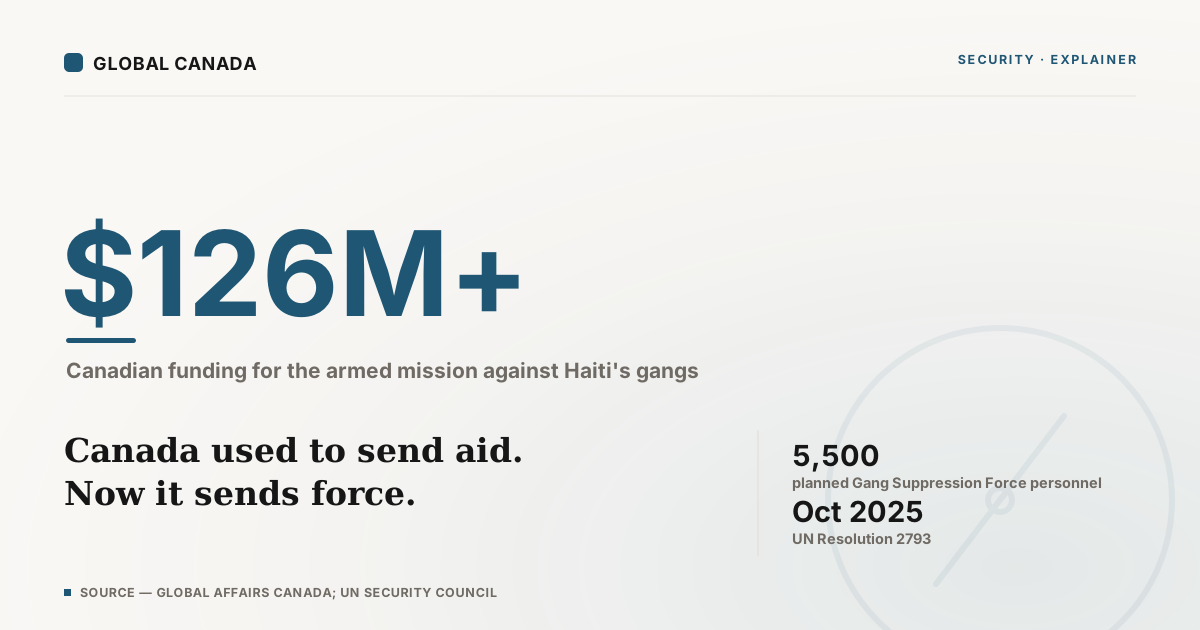
For most of the past two decades, Canada’s involvement in Haiti followed a familiar template: aid, development projects, election support, police training, the soft instruments of a middle power trying to help a troubled neighbour in the hemisphere. In 2026 the template has changed. Canada is now one of the two largest funders of an armed international force whose job is to hunt the gangs that have seized much of Haiti, and it has taken a seat among the partners directing the mission. The country that used to send assistance is now, in effect, helping to send soldiers.
The numbers mark the shift. Canada has committed more than 126 million dollars to the Gang Suppression Force and the mission that preceded it, plus another 7.5 million to the Haitian National Police, and has pledged tens of millions more. Alongside Germany, it is one of the top donors to the force’s trust fund, and it sits on the “Standing Group of Partners”, with the United States, Kenya, Jamaica, the Bahamas and others, that oversees the operation. This is not the vocabulary of development. It is the vocabulary of security.
How it came to this
The change in Canada’s posture is a response to a change on the ground so severe it is hard to overstate. Armed gangs have controlled large parts of Haiti, including critical infrastructure and much of the capital, since 2021, and the violence has reached a scale that overwhelms the language usually used for it: between March 2025 and January 2026, at least 5,519 people were killed in Haiti and thousands more injured. The Haitian state, for practical purposes, lost the ability to govern significant portions of its own territory.
The international response evolved in stages. A Kenyan-led Multinational Security Support mission went in first, under-resourced and struggling. In October 2025, the United Nations Security Council passed Resolution 2793, transforming that mission into a more muscular Gang Suppression Force, planned at 5,500 personnel and mandated to conduct intelligence-led operations against the gangs, make arrests and recover weapons. Canada’s money and its seat at the oversight table are part of that harder, more directly coercive turn.
The weight of history
Here is where honesty is required, because Haiti is not a blank slate for foreign intervention. It is one of the most intervened-in countries on earth, and the record is not encouraging. Previous international missions (including ones Canada took part in) promised stability and left disappointment, and sometimes worse, behind them. A UN peacekeeping mission introduced a cholera epidemic that killed thousands. Foreign forces have a long history of arriving in Haiti with good intentions and departing with the underlying problems intact.
So the questions that hang over the Gang Suppression Force are not cynical; they are earned. Can an externally funded, foreign-staffed force actually restore security in a way that holds once it leaves, or does it simply suppress the symptom while the political and economic roots of the crisis go untreated? What accountability exists when things go wrong, as they have before? And is Canada’s involvement a genuine effort to help stabilize a neighbour in agony, or a way of being seen to act on a crisis too close and too visible to ignore?
None of this argues that Canada should do nothing. The scale of Haitian suffering is real, the request for help is real, and standing aside has its own moral cost. But the shift from aid to armed force is a consequential one, and it deserves to be watched with clear eyes rather than waved through on good intentions. A relationship that used to be about development assistance now runs, in its most urgent corner, through a security mission in a country where such missions have failed before. Whether this one breaks the pattern is the question that matters, and it will not be answered by the size of the cheque.