Push through the door of almost any Tim Hortons at six in the morning and the air tells you where you are before your eyes do: warm, a little steamed-up, the sugar-and-yeast smell of the display case mixing with the hiss and knock of the coffee machine finding its rhythm. The lights have been on for hours. In the corner nearest the window, folded into the same vinyl booth they occupy every day, sits a cluster of regulars, usually older, usually men, though not always. Their coffees have gone lukewarm, because the coffee was never really the point. The staff know the orders before they are spoken. Nobody is hurried along. In a country that spends a good part of the year too cold to linger outdoors, this booth is quietly doing the work a public institution is supposed to do: keeping the door open and asking nothing in return.
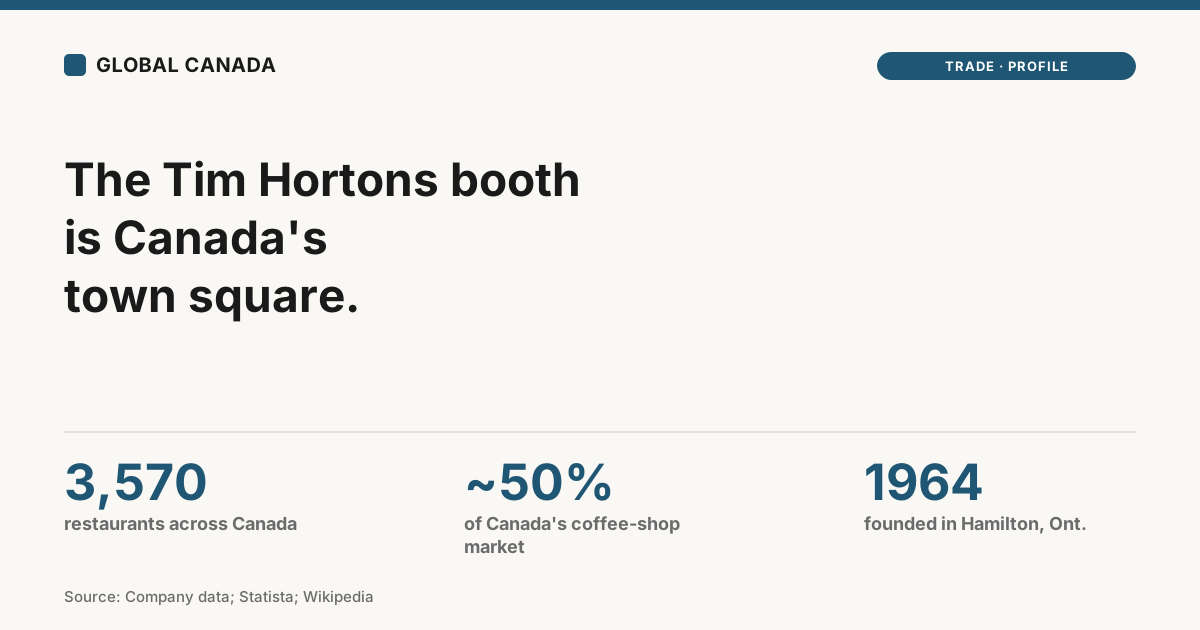
Tim Hortons is usually filed under “coffee chain,” which is accurate and misses the point. With 3,570 restaurants across Canada as of early 2026, more outlets than Starbucks and McDonald’s put together, and more than any other restaurant brand in the country, it is less a business than a piece of national plumbing. It stands at highway exits and in hospital lobbies, in bank-tower concourses and in towns too small for a traffic light. Ontario alone holds more than 1,800 of them. Many never close. Because it is everywhere, cheap and warm, it has drifted into a role no one ever assigned it: the nearest thing Canada has to a town square.
The regulars’ table
Spend a full day in one booth and the whole country files past. The retirees arrive first and stay longest; a single coffee buys a morning of company, and no one has ever been shown the door for nursing it. The parents come after the school run, strollers wedged between tables. Shift workers pass each other at the counter heading opposite directions, one ending a night, one starting a day. Teenagers annex a booth with a single box of Timbits split four ways. And on both sides of the counter stand newcomers to Canada, because for a great many immigrants a Tim Hortons is a first job and a first place to feel unremarkable, which in a new country is its own kind of welcome.
None of it is designed. It falls out of a few plain facts: the room is heated, the coffee runs under two dollars, the hours are long, and nobody times how long you sit. Sociologists call a place like this a “third place,” the ground between home and work where a community actually meets, the pub, the barbershop, the café on the square. Most countries have several. Canada, short on piazzas and warm evenings, loaded much of that weight onto a doughnut shop, and the doughnut shop, improbably, held.
Baked into the country
The origins explain the grip. The first store opened in 1964 in Hamilton, Ontario, its name borrowed from Tim Horton, a barrel-chested defenceman who spent the best of his career with the Toronto Maple Leafs and lent the shop his fame; a former Hamilton police constable named Ron Joyce supplied the ambition. Horton never saw what his name would become. He was killed in a car crash in 1974, and it was Joyce who turned a handful of stores into a coast-to-coast empire. There is something quietly Canadian in that, too: the icon on every cup a hockey player who died young, the engine behind it a cop from Hamilton.
The hockey lineage never left. Timbits minor hockey has laced up a generation of five-year-olds, and the pre-dawn arena run with a cardboard tray of double-doubles is among the more honestly Canadian rituals going. The language stuck as well. “Double-double,” two creams and two sugars, coined in the drive-thru boom of the early 1980s, had earned a place in the Canadian Oxford Dictionary by 2004. “Roll Up the Rim,” born in the mid-1980s from a cup-supplier’s idea to hide a prize under a paper rim, turned a disposable coffee cup into an annual national lottery. Small things, all of them. But a country’s shared vocabulary is assembled out of small things, and this one supplied more of Canada’s than most institutions with far grander mandates.
What Canada exports without noticing
There is a Global Canada angle here, and it is gentler than the usual trade story. The chain now runs some 6,000 restaurants across fourteen countries: more than 900 in China, spread over seventy-odd cities; a few hundred through the Gulf; dozens in the United Kingdom since it landed in Glasgow in 2017; and, most recently, its first outlets in India and Pakistan. What crosses the border is not coffee. Espresso cultures do not need a Canadian chain to explain the bean. What travels is the format, the unpretentious, all-are-welcome, stay-as-long-as-you-like room, priced so that everyone can afford the cost of admission. It is a modest cultural export, the everyday kind that never makes it into a foreign-policy strategy, and it lands because the thing it offers, somewhere warm and cheap to simply be, turns out to translate almost anywhere.
Back home the booth keeps up its quiet civic work, and its owner keeps building: Restaurant Brands International and its franchisees have earmarked roughly $400 million to open eighty new Canadian stores and renovate hundreds more through 2026. Canada never voted to make a coffee chain its commons, and no statute will ever name it one. But at six in the morning, in a thousand towns at once, the lights are on, the regulars are already at their table, the door is open, and the country is, in its low-key way, assembled.
Reading list
- ScrapeHero, “Number of Tim Hortons locations in Canada” (2026)
- Statista, Tim Hortons statistics & facts (market share and locations)
- Histories of Tim Horton, Ron Joyce, and the 1964 founding in Hamilton
- Coverage of Tim Hortons’ international expansion (China, the Gulf, the UK, India and Pakistan)