At 12:01 p.m. Eastern on the Friday after American Thanksgiving, the number peaked: $5.1 million in sales a minute, flowing through servers run out of Ottawa. Over the four days from Black Friday to Cyber Monday, shoppers spent US$14.6 billion with merchants on Shopify’s platform, a record, up 27 per cent on the year, more than 81 million buyers in nearly every time zone on Earth. The sellers ranged from global brands to the 15,800 people who made the first sale of their lives that weekend. If you were listing the most globally consequential Canadian companies, Shopify would sit near the top. Most people, including most Canadians, do not think of it as Canadian at all.
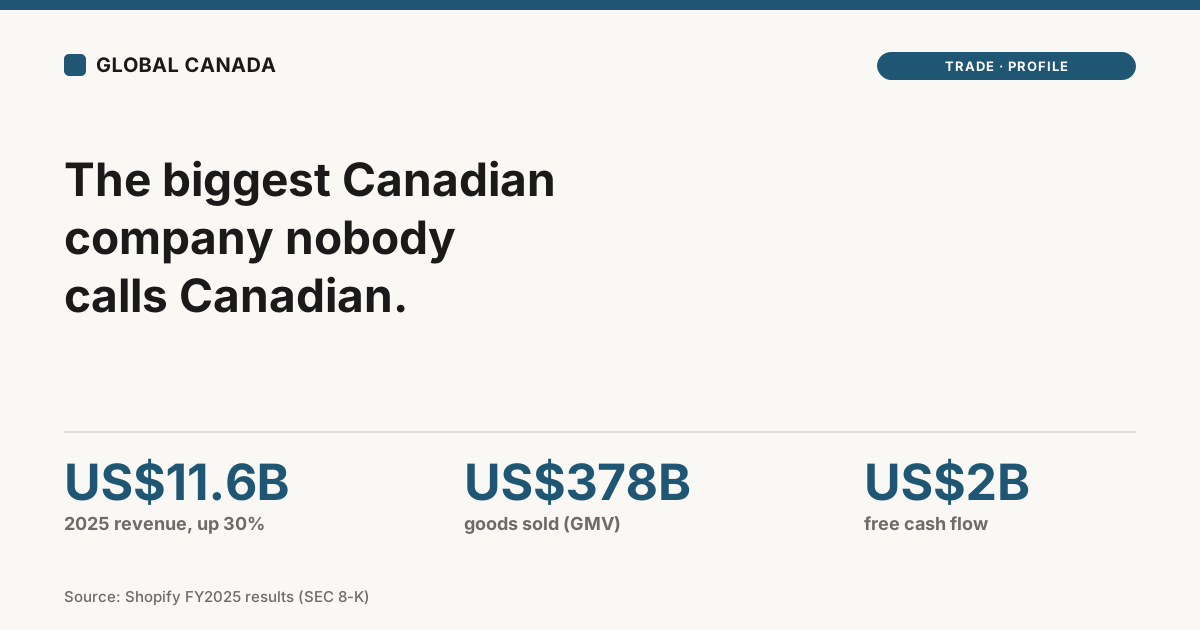
The scale is not a holiday-weekend illusion. Shopify posted US$11.5 billion in revenue for 2025, up 30 per cent, on gross merchandise volume of US$378 billion. Free cash flow reached US$2 billion, the milestone that turned it from a growth story into a durable one, and it launched a US$2 billion share buyback on the strength of it. This is infrastructure, not a boutique: for a growing share of the world’s independent retailers, Shopify is simply the plumbing through which commerce runs.
The bet on AI-run commerce
Shopify’s leadership has staked the next phase on artificial intelligence becoming the layer commerce runs through, rather than the dashboard a merchant clicks. Its “Sidekick” assistant and a proposed universal commerce protocol are the wager: that a shopkeeper will increasingly run the business by talking to software, and that autonomous “agents” will do some of the buying. The company points to a large majority of retailers already using or testing AI tools, and to the conversion lift its Shop Pay drives on mobile checkouts. Whether that agentic future arrives on Shopify’s timeline is unproven. The company is not hedging on it.
The quiet trade story
The part that ties Shopify to foreign policy is the one it markets least. Its founding promise, to make commerce easy for people without capital or connections, has a real development dimension. The platform lets an artisan in Ghana, a textile maker in Bangladesh or a coffee exporter in Colombia sell directly to a customer in Berlin or Toronto, skipping the wholesalers and importers who historically captured most of the value. That is trade liberalization by software: no treaty, no tariff schedule, just a lowered barrier to reaching a global buyer.
It maps almost too neatly onto things Canada says it wants: digital-trade chapters in its economic-partnership agreements, a development agenda about enabling entrepreneurs in the Global South. Shopify does a version of that at commercial scale, and none of it is policy. The tools quietly do the work that trade negotiators write clauses about.
The champion Canada won’t name
Which raises a question the company seems uninterested in. Shopify’s chief executive, Tobi Lütke, is German-Canadian; the firm is headquartered in Ottawa but runs as a fully distributed, borderless workforce. Unlike Tim Hortons, it carries no brand nationalism whatsoever. It is understood as a platform, not a Canadian one, and that is a deliberate, probably shrewd, commercial choice.
It also leaves a gap in how Canada thinks about itself. France built a national story around Mistral; South Korea around Samsung; the United States turns its technology firms into instruments and symbols of national power almost by reflex. Canada has, in Shopify, a company of comparable global reach, and has never built a “Canadian tech champion” narrative around it. Economic-nationalist branding carries costs, and a company that belongs to everywhere may not want to be anyone’s flag-bearer. Still, it is a strange thing for a country short on champions to leave a company this size sitting quietly on the table, claimed by no one.
Reading list
- Shopify Q4 and full-year 2025 results (SEC Form 8-K)
- Shopify BFCM 2025 sales release
- Coverage of Shopify’s universal commerce protocol and “Sidekick” AI tools
- Canada’s economic-partnership agreements: digital-trade chapters