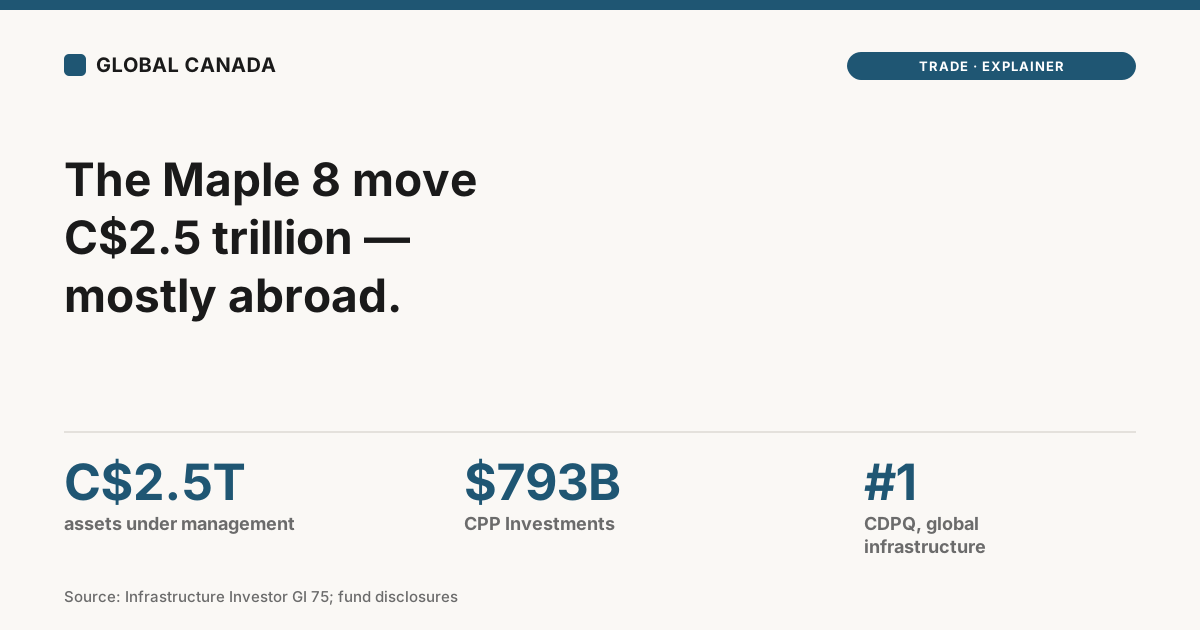
If you have ridden a toll road outside London, moved through a European data centre, or watched a light-rail line rise across Montreal, there is a reasonable chance the capital behind it traces back to a Canadian retiree’s pension. Canada’s eight largest public pension funds (the group known in finance circles as the Maple 8) manage roughly C$2.5 trillion between them. That is more than the annual output of most G20 economies, deployed almost entirely abroad, and it is one of the strangest blind spots in how Canada thinks about its place in the world: the country’s single largest global investment arm barely appears in Canadian foreign-policy conversations at all.
Consider the scale. CPP Investments held $793.3 billion in assets at its fiscal year-end in 2026, run out of offices in Hong Kong, London, Mumbai, New York, San Francisco, São Paulo and Sydney, a network that would flatter a mid-sized foreign ministry. CDPQ, the Caisse de dépôt et placement du Québec, held $473 billion as of late 2024 and ranked first in the world for infrastructure in Infrastructure Investor’s Global Investor 75, ahead of Blackstone, Brookfield and Global Infrastructure Partners. OMERS runs a direct infrastructure book near $27 billion; CPPIB’s infrastructure exposure runs above $37 billion and includes European data-centre joint ventures announced in late 2025. This is not portfolio investing at the margins. It is ownership of the physical plumbing of other countries’ economies.
The revolution nobody voted on
The reason Canadian funds punch so far above the country’s economic weight is a set of governance decisions made quietly in the 1990s, now known abroad as the “Maple Revolution” or simply the Canadian model. The idea was to sever public pension management from government: give the funds operational independence, hire professional investors rather than civil servants, and let them invest globally in private assets (real estate, infrastructure, private equity) that most public funds were too cautious or too politically constrained to touch.
The results validated the theory. CDPQ ranked first among pension funds in Global SWF’s 2024 governance-and-sustainability scoreboard and carries a AAA rating from all four major credit agencies. The independence is real and, by most measures, has served pensioners well. It has also produced a peculiar outcome: institutions with the reach of sovereign wealth funds and none of the coordination. Norway’s Government Pension Fund Global and Australia’s Future Fund operate within a framework that connects their investing, however loosely, to national strategy. Canada has no such mechanism. The Maple 8 invest as long-term financial actors, and Ottawa has no formal way to align (or even discuss aligning) where that money goes with what the country is trying to achieve abroad.
For decades that was the whole point, and defensibly so. Political control over pension capital is exactly the kind of thing that ends in scandal and lost returns. But the world the model was built for has changed.
Where the questions start
Infrastructure has become geopolitical. Funds raised nearly $300 billion globally in 2025, a record, and the fastest-growing slice is digital, data centres, the physical substrate of the AI boom. CPP’s joint venture with Goodman Group to build data centres across Frankfurt, Amsterdam and Paris is a direct wager on that build-out. Which is fine, until you notice that ports, power grids, telecoms and data centres are precisely the assets that governments have started treating as strategic, the things they screen foreign buyers for, and occasionally seize. A Canadian pension fund building critical infrastructure in a country that later decides to weaponize its ownership is not a hypothetical risk so much as an unpriced one.
Currency has bitten too. The weakening U.S. dollar through 2025 dragged on Canadian pension returns heavily exposed to American assets; Ontario Teachers’ more than halved its dollar exposure over the year, and OMERS moved to a more flexible hedging stance. And the funds have begun to diverge on climate governance in ways that look political even when they are framed as prudential. CPPIB walked back its net-zero target in 2025, citing compliance anxiety under Canada’s anti-greenwashing rules, a retreat that sat awkwardly against the country’s stated climate diplomacy.
None of this means the model is broken. It means the model now produces foreign-policy consequences whether or not anyone in Ottawa intends them.
The test at home
The most interesting question may be whether the Canadian model works in Canada. CDPQ Infra is leading Alto, the long-promised high-speed rail link along the Québec City–Toronto corridor, through a consortium that includes AtkinsRéalis, SYSTRA, Keolis, Air Canada and SNCF Voyageurs. CDPQ has also set a $100 billion Quebec investment target for 2026, a deliberate tilt of capital homeward. If the funds that built transit systems and toll roads abroad can deliver high-speed rail at home, a thing Canada has talked about for half a century and never built. It would answer a quiet criticism that the Canadian model exports competence it will not spend domestically.
The Carney government has said it wants to diversify Canada’s economic relationships and attract enormous new investment. It has C$2.5 trillion of Canadian institutional capital already deployed across exactly the markets it is courting. Whether it ever builds a mechanism to align that capital with the Indo-Pacific Strategy or the critical-minerals push, without wrecking the independence that made the funds worth aligning in the first place, is the needle it has not yet tried to thread.
Reading list
- Infrastructure Investor: Global Investor 75 ranking (2025)
- CPP Investments quarterly disclosures (FY2026); CDPQ 2024 Annual Report
- Benefits Canada: Maple 8 overview (2026)
- Global SWF: 2024 Governance, Sustainability and Resilience Scoreboard
- CDPQ Infra materials on the Alto high-speed rail project