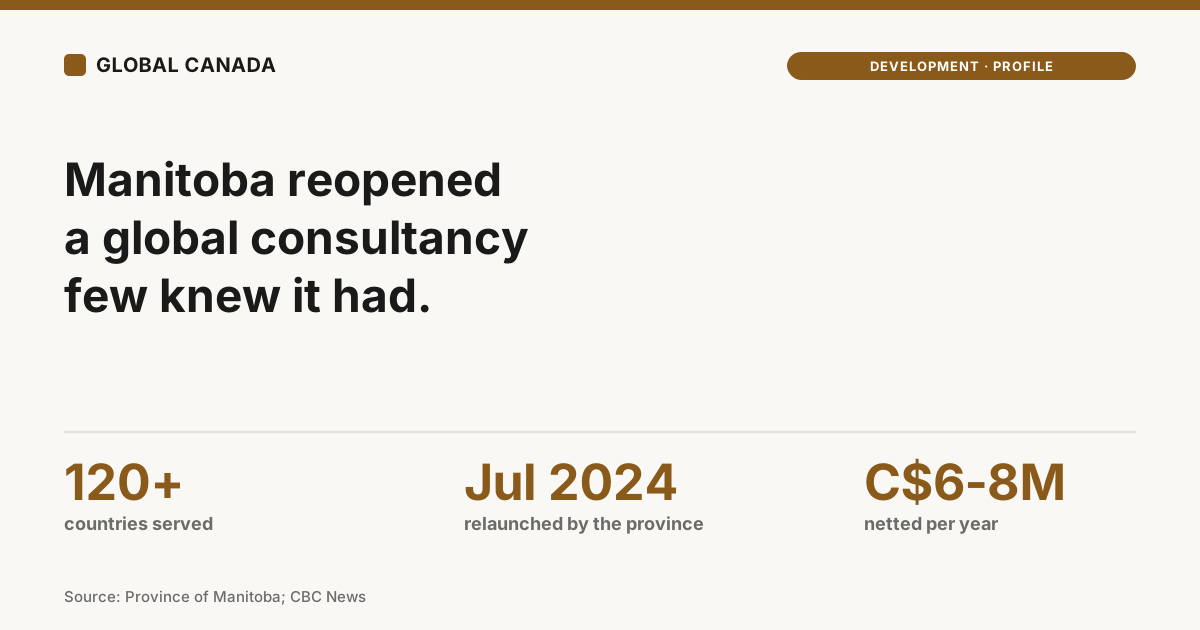
The client list reads like the membership roll of the global development-finance system: the World Bank, the Asian and African Development Banks, the EBRD, the EIB, the Inter-American Development Bank, the Millennium Challenge Corporation, Sweden’s Sida, France’s AFD, Germany’s GIZ. The firm they hire, in more than a hundred countries, to advise electric utilities and governments on how to run and modernize their grids is not a Wall Street consultancy or a European engineering giant. It is Manitoba Hydro International, a publicly owned subsidiary of a provincial Crown utility, working out of Winnipeg. Its engineers turn up where the grid is thin, a control room in South Asia, a substation on an East African plain, and bring the one thing a consultant usually cannot: the muscle memory of a company that actually runs a big northern grid through real winters.
Most Canadians have never heard of it. Fitting, because a few years ago it very nearly ceased to exist.
Shut down, then switched back on
In February 2021 a reorganization of Manitoba Hydro moved to wind MHI down. The worry was risk: an independent review found the firm had exposed Manitoba ratepayers to liability by taking work in high-risk countries, and that the parent utility’s own customers had in effect subsidized it through shared use of assets. It was a defensible concern, and the wind-down looked like the end of a long institutional story.
Then, in July 2024, Manitoba’s NDP government reversed course. MHI was relaunched and, in the finance minister’s words, began “once again” bidding on energy projects around the world. The case for reopening was mostly arithmetic. Over roughly two decades MHI had netted an average of C$6 to 8 million a year, money that flows back toward holding down domestic hydro rates, and the year of dormancy had cost the province tens of millions in lost work. It also kept high-skill technical jobs in Winnipeg. A public utility that can earn commercial income abroad to subsidize its own ratepayers at home is a genuinely unusual asset, and the province decided it had thrown one away.
The niche almost no one else fills
What makes MHI interesting beyond Manitoba’s rate base is the gap it occupies. It is a publicly owned utility-consulting firm with a century of real operating experience behind it, available to developing-country governments at rates the development banks are willing to fund. Private consultancies charge more and answer to shareholders; MHI answers to a province and arrives with the credibility of an operator that runs a large grid rather than merely advises on one. That combination is rare, and it lines up with a surge in demand: as the energy transition accelerates, developing countries need exactly what MHI sells, grid modernization, renewable integration, high-voltage testing, operator training, and the World Bank, the ADB and the AIIB, which fund that work, are already its clients. FinDev Canada, the country’s own development-finance institution, is a natural co-financing partner, which hints at a coordinated Canadian development play that mostly does not yet exist but could.
A public asset, put back to work
The relaunch is a considered judgment about how a public asset should earn its keep. Sending a provincially owned firm to compete for grid contracts abroad carries the ordinary risks of international business, and Manitoba, having paused MHI once, went back in with its eyes open. What it concluded on second look is that the upside is worth it: commercial revenue that flows to ratepayers, high-skill jobs at home, and a rare Canadian instrument for energy development in the countries that need it most. It is a small story with a large idea inside it, that a public utility’s century of hard-won expertise is itself an exportable asset, able to do good abroad and pay its way at home. In a world racing to modernize and decarbonize its grids, the timing looks apt.
Reading list
- Province of Manitoba: MHI restart announcement (July 2024)
- CBC News: coverage of MHI’s revival and 2021 wind-down
- Manitoba Hydro International company profile and project record
- Province of Manitoba: 2021 MHI review findings