When Canada launched its Indo-Pacific Strategy in 2022, India was supposed to be the anchor. It was the fast-growing democracy, the counterweight to China, the market Canada’s export-diversification dreams were pinned to. Then the relationship collapsed, publicly, bitterly, over allegations that pushed the two governments to expel each other’s diplomats, before the strategy’s own offices were fully staffed. It is a rare thing to watch a foreign-policy document lose its cornerstone before the ink dries. That collapse, and the slow repair that followed, is the sharpest lens available on what Canada’s Asia strategy can and cannot deliver.
The reset, and what it actually produced
The thaw began where these things often do, on the margins of a summit. Prime Ministers Modi and Carney met at the G7 in Kananaskis in June 2025 and agreed to restore full diplomatic representation and resume visa services, the diplomatic equivalent of turning the lights back on. By March 2026, Carney was in India, and the visit produced more than atmospherics: the launch of bilateral trade negotiations (a comprehensive economic partnership agreement, with the stated aim of concluding by the end of 2026), a uranium deal, and a trilateral technology arrangement with Australia.
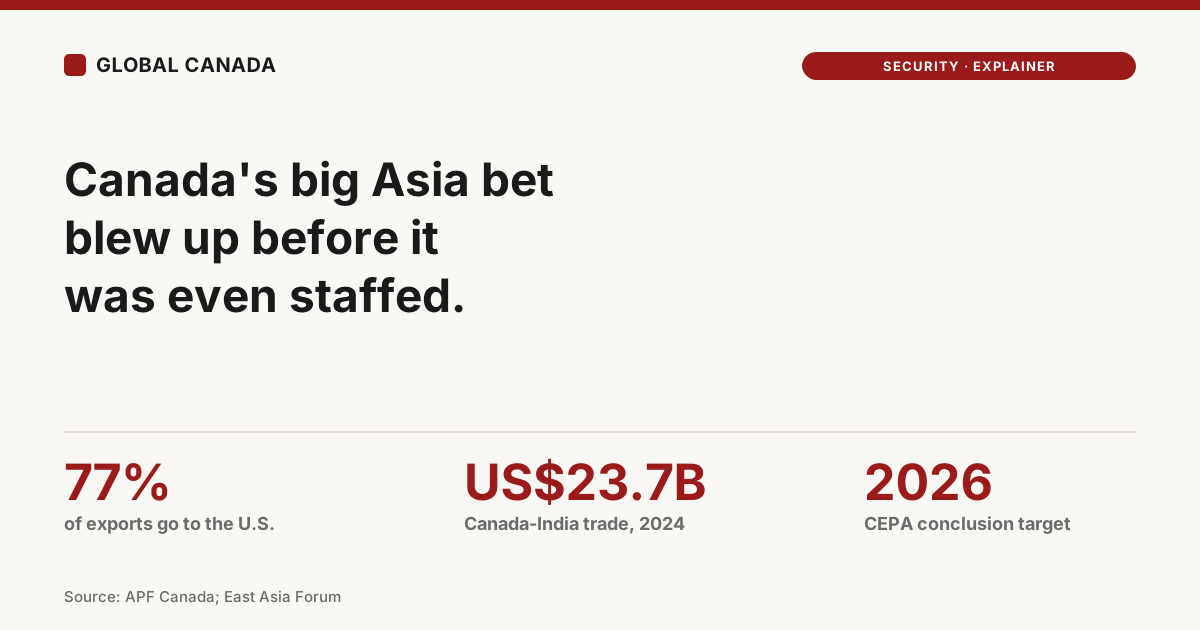
The economics explain the willingness to rebuild. Canada–India trade in goods and services ran around US$23.66 billion in 2024, and the complementarity is real: India needs Canadian pulses, fertilizers and, increasingly, critical minerals; Canada wants Indian market access and skilled workers. Interests survived the rupture even when trust did not. Whether a full trade agreement can be concluded within a year of the two capitals accusing each other of extraordinary things is the open wager of the whole relationship.
The partners that held
The quieter success of the Indo-Pacific Strategy is that its second-tier relationships turned out to be its most solid. With Japan, Canada moved fast: a Security Information Agreement in July 2025, an Equipment and Technology Transfer Agreement in January 2026, and a Carney visit in March 2026 to meet Prime Minister Takaichi. With South Korea, the security architecture deepened along similar lines. Operation HORIZON now sends three Royal Canadian Navy warships to the Indo-Pacific each year, a modest but recurring physical presence, which in this region counts for more than communiqués. Canada and Indonesia signed a comprehensive economic partnership, with new defence-cooperation memoranda attached.
None of these are as large as the India prize was supposed to be. But they are done, or nearly so, while India remains a negotiation. There is a lesson in that about where Canada’s Asia strategy has real traction, with the middle powers of the region rather than its giants.
The China question, handled the way India handles China
Carney’s visit to China in early 2026 was the first by a Canadian prime minister since 2017, and it produced agreements easing the long-running tariff fights over canola and electric vehicles, plus a new strategic-partnership framework. The approach on display was compartmentalization: engage Beijing on trade and climate where it serves Canadian interests, stay vigilant on security, and refuse to treat the relationship as all-or-nothing.
This is, almost exactly, how India manages China, and it has drawn criticism from Canadian security analysts who see compartmentalization as a polite word for lowering one’s guard. The counter-argument is that a middle power dependent on trade cannot afford the purity of total confrontation with the world’s second-largest economy. Both readings are defensible; the strategy has chosen the second, and the choice will be judged on whether the security vigilance is real or merely stated.
The number the whole strategy is trying to move
Underneath the diplomacy sits a single stubborn figure: roughly 77 percent of Canada’s exports go to the United States. That dependence is the baseline problem the Indo-Pacific Strategy exists to solve, and Carney’s targets (double Canada’s non-U.S. trade, attract $1 trillion in new investment over a decade) are aimed squarely at it.
The strategy has done the institutional groundwork. Export Development Canada has opened or expanded trade-finance offices across the region: Jakarta, Seoul, Tokyo, Ho Chi Minh City, Manila, Bangkok. Diplomatic staffing is up. What remains thin is the conversion of all that presence into specific commercial outcomes: the deals, the supply chains, the redirected trade flows that would actually move the 77 percent. The clearest concrete achievements so far are security-flavoured (the dark-vessel detection program in the Philippines that tracks illegal fishing, the recurring HORIZON deployments) rather than the trade wins the strategy was sold on.
That may be the most honest summary of Canada’s Indo-Pacific project at the midpoint of 2026: the architecture is built, the relationships are broader and in several cases deeper than before the India rupture, and the central economic promise remains mostly unredeemed.
Reading list
- Asia Pacific Foundation of Canada: Indo-Pacific Outlook 2026
- “Canada’s Indo-Pacific strategy requires rethinking ‘like-mindedness,’” East Asia Forum (2026)
- “From Rupture to Reset: The Slow Repair of India–Canada Relations” (2026)
- Government of Canada: Canada–Japan Security Information Agreement (2025)
- Policy Magazine: coverage of Carney’s Indo-Pacific diplomacy (2026)