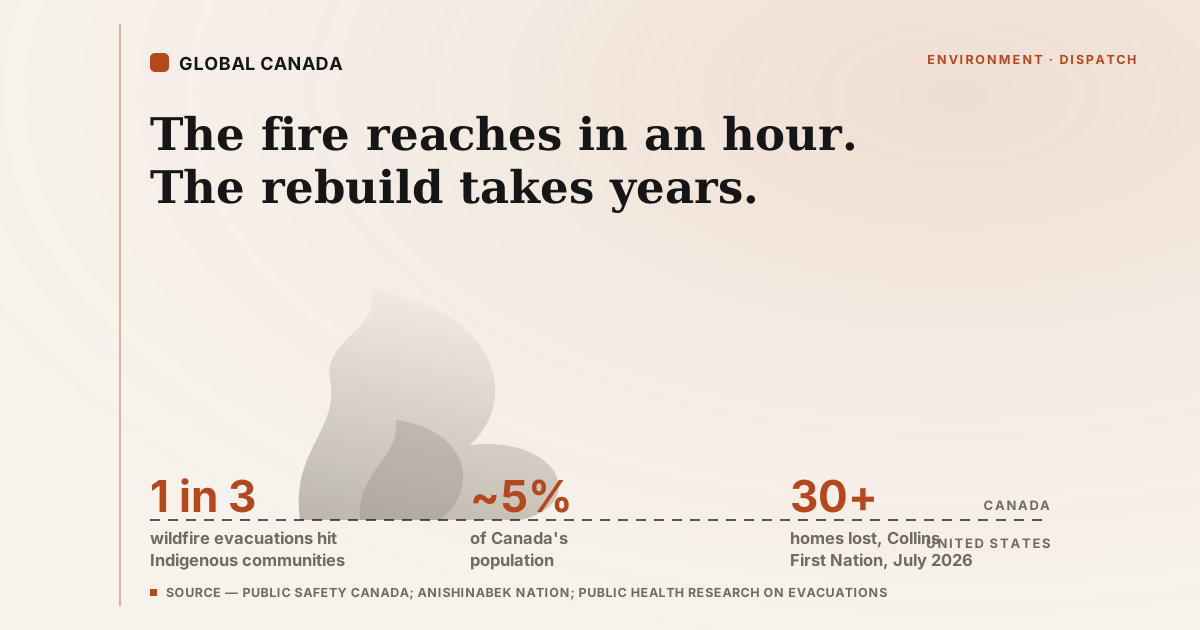
On July 13, 2026, the people of Namaygoosisagagun were told there was no immediate danger. Within the hour the wildfire had jumped the natural breaks around the community, known also as Collins First Nation, a remote settlement in northwestern Ontario with no road in, reachable only by rail line and by Collins Lake. The roughly two dozen people there when the flames arrived carried elders and children into boats and crossed the lake to get out. By the time the fire passed, more than 30 homes were gone, along with the school, the administration office and the community centre, according to Linda Debassige, grand council chief of the Anishinabek Nation, in remarks reported by CBC News. The community had been standing that morning. By evening most of it was ash.
Collins is one community in a season Canada has learned to expect. As of July 9, Public Safety Canada counted 3,137 fires and 1.4 million hectares burned, with 796 fires still active and 60 of them out of control. The totals sit below the five-year average, a fact ministers repeat, and it is cold comfort in the places the fire actually reaches. By mid-July, 13 First Nations had been evacuated and roughly 2,180 of their residents were living somewhere that was not home.
The same five per cent, every year
The overrepresentation is not a coincidence of a single bad year. Roughly one in three wildfire evacuations in Canada over the past three decades has emptied an Indigenous community, in a country where Indigenous people are about five per cent of the population. In 2025, the second-worst fire season on record, three of every five people evacuated nationwide were from a First Nation.
Geography explains part of it. Many First Nations sit inside the boreal forest, exactly where the fires burn, and many are fly-in or single-road communities with one way out. When the wind turns, they cannot stage the fast, orderly departure a city can. They queue, or in Collins’s case, they paddle. The housing explains the rest. On-reserve homes are chronically underfunded, more likely to be older and built with materials that offer less fire resistance, and less likely to have had the money for the cleared, defensible space that slows a fire at the treeline.
The social cost: nowhere to put people
Getting out is the start of the ordeal. Evacuees from the Ontario fires were sent to Thunder Bay, where the hotels filled and then ran out. About 100 people from First Nations under evacuation orders ended up sleeping in their cars because there were no rooms left. The system moves people to the nearest city and discovers, each time, that the nearest city was never resourced to hold them.
The displacement does its quietest damage inside families. Evacuation registers split households across hotels and reception centres in different towns; elders are separated from the people who cook for them and translate for them; children spend weeks out of school with no fixed address. “Behind every evacuation are families forced to leave home, Elders separated from their support networks, and children living with uncertainty,” Mandy Gull-Masty, the minister of Indigenous services, said in a statement issued on July 9, 2026. Emergency researchers have made the same point in plainer terms: evacuations that break up families and scatter a community do harm that outlasts the fire, which is why keeping households together has become a stated goal rather than an assumed one.
The economic cost: burned in an hour, rebuilt over years
A remote community can be destroyed in an afternoon and take the better part of a decade to come back. Reconstructing a place like Collins, with no road and everything hauled in by rail, water or air, is a logistical project measured in years and, across the run of communities hit in recent seasons, in hundreds of millions of federal dollars. The house is only the visible loss. When the administration office, the school and the community centre burn, so do the records, the payroll, the classrooms and the one building where the community governs itself.
The deeper economic hit is to the land itself. Fire and evacuation sever access to hunting, fishing and foraging, which for many First Nations are not recreation but the food supply and a part of the household economy. A season spent in a Thunder Bay hotel is a season of moose not hunted, fish not caught and berries not picked, and the bill for replacing that food with store-bought groceries lands on households that were already stretched.
The public spending is not obviously keeping pace. Ontario’s 2026-27 budget set its emergency forest-firefighting allocation at $150 million, below the $271 million the province actually spent the year before. Ontario calls that a base figure it tops up when a season runs hot; its critics note it has again budgeted well under what the last season truly cost. Ottawa, for its part, put $1.25 million into six preparedness projects with Métis and First Nations partners in July, including training for up to 38 Indigenous wildland firefighters.
The psychological cost: the fire after the fire
The hardest injury to cost is the one to the mind. Wildfire evacuation is associated with new or worsening post-traumatic stress, depression, anxiety and, in some cases, psychosis. For First Nations the exposure runs deeper, because being ordered from your home and bused to a distant institution echoes a history the state authored: residential schools, forced relocations, children taken elsewhere “for their safety.” An evacuation can reopen that wound, a phenomenon clinicians describe as re-traumatization, and the connection to the land that is central to identity and wellbeing is precisely what the fire cuts.
The care that follows is thin. Mental-health support after wildfire tends to arrive late, leave early, and come in a form that was not designed for Indigenous patients, inadequate, often culturally inappropriate, and rarely funded for the years a real recovery takes. The counsellor flies out when the evacuation order lifts. The grief does not.
The smoke that gets noticed
What crosses the border is not the trauma. It is the smoke. In July 2026, as in 2025, plumes from the Canadian fires pushed south and drove air-quality readings in parts of the United States to hazardous levels, and the smoke, unlike the people underneath it, reliably makes the American news.
The politics it generates travel in one direction. In the summer of 2025, six Republican members of Congress from Wisconsin and Minnesota wrote to Canada’s ambassador demanding a forest-management plan. “While we know a key driver of this issue has been a lack of active forest management, we’ve also seen things like arson as another way multiple large wildfires have ignited in Canada,” the letter read. A separate group of Michigan representatives wrote to Prime Minister Mark Carney complaining that their constituents could not safely go outside. Manitoba’s premier, Wab Kinew, whose province was then counting its dead, called the signatories “attention-seekers” throwing a “timber tantrum.” “They’re playing games with something that’s very serious,” he told the Canadian Press in August 2025, in remarks reported by CBC News. He also thanked the American crews who had come north to help, and noted Canadian crews had gone south during California’s fires. The cooperation on the fire line is real. The letters were something else.
There is a serious cross-border question underneath the theatrics, and it is not about raking forests. Wildfire smoke is now a shared public-health exposure: the same particulate that closes a Minnesota playground keeps an evacuated elder from Collins indoors in a Thunder Bay hotel room. A mature bilateral response would treat the airshed as a joint problem, the way Canada and the United States already treat the Great Lakes, rather than as a grievance to be mailed to an ambassador.
For now, the people of Namaygoosisagagun are in that hotel, or in a car, waiting to learn when a community with no road can be rebuilt from the water up. The fire took under an hour. Everything after it is measured in years.
Sources
- 2026 season national figures and federal response (3,137 fires and 1.4 million hectares by July 9; the minister of Indigenous services’ statement; $1.25M for six preparedness projects and training for up to 38 Indigenous firefighters): Public Safety Canada
- Namaygoosisagagun (Collins First Nation) destruction, and Anishinabek Nation Grand Council Chief Linda Debassige’s account of the losses: CBC News
- Evacuees housed in Thunder Bay hotels, and sleeping in cars once rooms ran out: Canada’s National Observer
- Disproportionate impact on First Nations (about one in three evacuations over three decades; three in five in 2025): CBC News; Public Safety Canada (2025)
- Ontario’s emergency forest-firefighting budget ($150M for 2026-27 against $271M spent the year before): Canada’s National Observer
- 2025 U.S. congressional letters and Premier Wab Kinew’s response: CBC News
Figures as of July 2026.