Deep inside a mountain in Colorado, and in a lower-profile operations centre in North Bay, Ontario, there is a room where the officer giving the orders might be Canadian and the officer taking them might be American, or the other way around, and no one in the room finds this remarkable. It is the ordinary condition of NORAD, and it is genuinely strange. Nowhere else on the planet do two sovereign countries hand a single military command the authority to watch and defend their combined airspace, with a chain of command that runs across the border as if the border were not there.
The North American Aerospace Defense Command turns sixty-eight this year. It has outlasted the Cold War that created it, the missile it was built to detect, and every diplomatic squall between Ottawa and Washington in between. And in a year when the two governments are trading tariffs and insults, the least noticed fact about the relationship may be the most important: they are also, together, spending more to modernize their shared defence than at any time in two generations.
What NORAD actually is
Skip the acronym for a second and look at the arrangement, because the arrangement is the point.
NORAD was stood up in 1958, when the threat was Soviet bombers coming over the pole and neither country could see far enough north to do anything about it alone. The deal was simple and, for a sovereign state, remarkable: Canada and the United States would treat the airspace above the continent as a single problem, watch it with a single integrated command, and accept that the commander (an American, by convention, with a Canadian deputy) could act on behalf of both. Canada gave up a measure of autonomy. In return it got a say in the defence of its own skies that it could never have mustered on its own, and a permanent seat inside American continental planning.
That bargain has held through everything. During the Cuban Missile Crisis, through the long vigil of the Cold War, on the morning of September 11 when NORAD scrambled fighters over a continent, and up to today, the binational command has kept functioning as designed. Governments have disagreed loudly about trade, Iraq, pipelines, softwood lumber. The two-nation watch over the North has never seriously been in question.
The rebuild
For decades the uncomfortable secret of NORAD was that its eyes were going blind. The North Warning System, the radar line strung across the Arctic in the 1980s, was built to spot a slow bomber, not the low-flying cruise missiles and hypersonic weapons that now define the threat. Everyone knew it. Almost nothing was done, for years, because modernization is expensive and the Arctic is unforgiving.
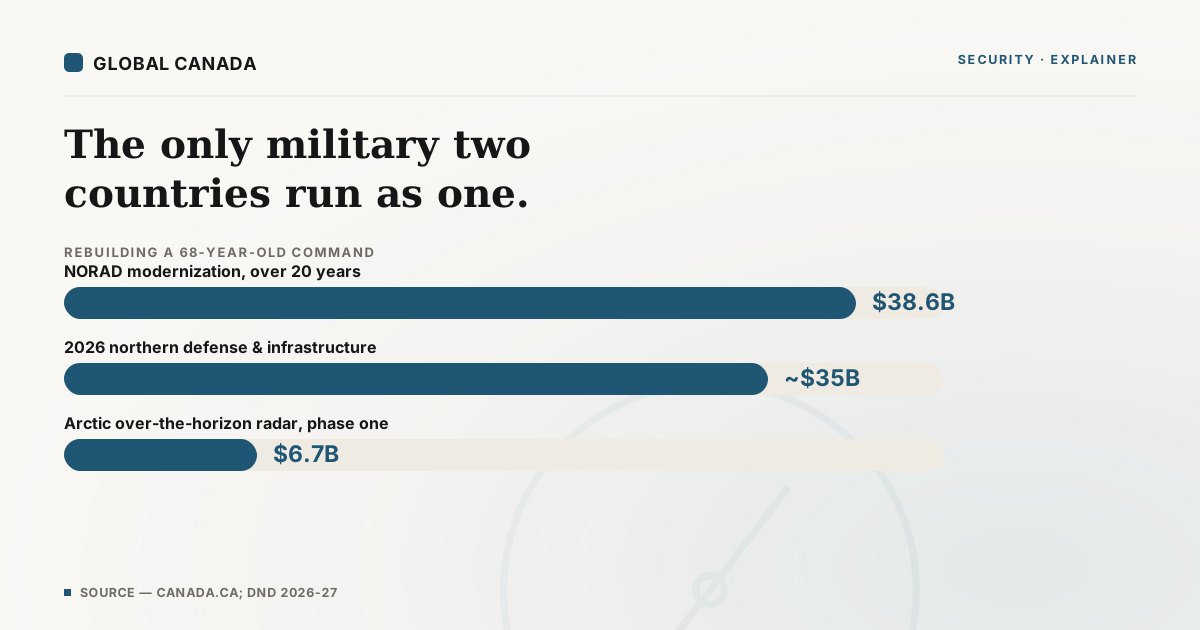
That has changed. In 2022 Canada committed to a NORAD modernization plan valued at 38.6 billion dollars over two decades, on a cash basis, closer to 87 billion: the largest investment in the command’s Canadian half in a generation. In 2026 the Carney government layered on roughly 35 billion dollars more for northern defence and infrastructure, most of it inside the same envelope: new airfields, upgraded runways and hangars, roads, and above all new sensors. The centrepiece is an Arctic over-the-horizon radar, a system that can see far beyond the curve of the earth, with a first phase priced around 6.7 billion dollars.
These are not parallel national projects that happen to point the same way. They are investments in a shared system. A radar that watches the approaches to the continent watches them for both countries; a northern airbase that can launch interceptors serves the binational command, not one flag. The United States is investing on its side in the same modernization. What Canada is buying, in effect, is a renewed stake in a defence it cannot provide for itself and would be reckless to try.
The awkward parts
Two honest caveats keep this from being a simple good-news story.
The first is that “binational” has limits, and they surface in the Arctic. Ballistic-missile defence (the interceptors meant to stop a warhead rather than a bomber) sits outside NORAD’s traditional remit, and Canada has long declined to formally join the American missile-defence system. As the northern threat blurs the old categories, that gap invites an argument the two countries have been postponing for twenty years. Modernizing the radar is the easy part. Deciding what the two countries will actually do with what the radar sees is harder.
The second is procurement independence, which cuts against the seamless picture. Canada bought the core of its new over-the-horizon radar capability not from an American supplier but from Australia, in a deal worth around 1.8 billion US dollars. It is a small thing set against the whole, and Australia is as close an ally as they come. But it is a signal that even inside the most integrated defence relationship on earth, Ottawa is quietly keeping some options open, hedging, in the North as everywhere else this year.
Neither caveat undoes the core. Sixty-eight years into the arrangement, two countries that are otherwise squabbling are writing enormous cheques to keep watching the same sky together, on a timeline that stretches past 2040. In a relationship measured lately by what divides it, NORAD is a standing monument to how much the two countries still, without much fuss, simply assume about each other.