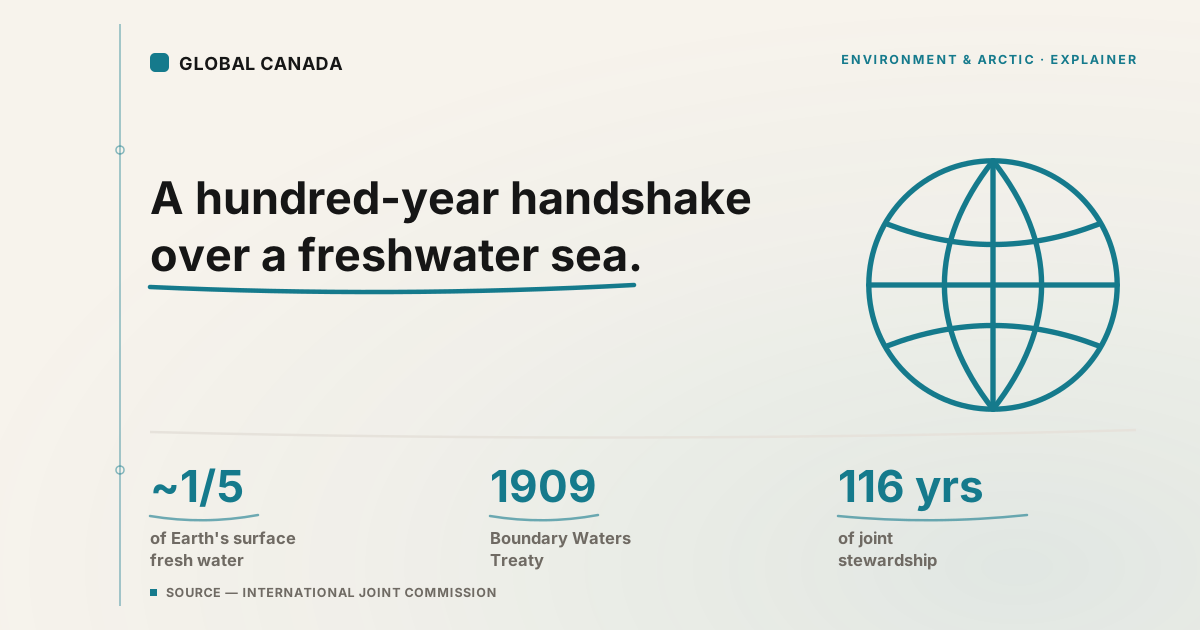
There is a body of water on the Canada–US border that holds roughly a fifth of all the fresh water on the surface of the planet. Not a fifth of North America’s: the planet’s. The Great Lakes are, by that measure, one of the most valuable natural assets on earth, and for more than a century two countries have managed them together under a treaty older than the airplane, the income tax, and both nations’ modern politics.
The treaty is from 1909. It is called the Boundary Waters Treaty, and its central insight was almost radical for its time: that two sovereign countries sharing a continent’s worth of rivers and lakes would inevitably quarrel over them (over dams, diversions, pollution, levels) and that the sane thing to do was build a permanent, binational body to settle those quarrels before they became crises. So they created the International Joint Commission: six members, three appointed by each country, tasked with preventing and resolving disputes over the waters the two nations share. It still exists. It still meets. It is one of the oldest continuously functioning international institutions on the continent.
The machinery of not fighting
What makes the Boundary Waters arrangement remarkable is not any single decision. It is the sheer, unglamorous durability of the thing.
Under the treaty sits the Great Lakes Water Quality Agreement, the working compact through which Canada and the United States pursue a deceptively simple goal: lakes that are, in the agreement’s own plain phrase, “drinkable, fishable, swimmable.” The Commission’s job is to hold both governments’ feet to that fire: to assess, independently, whether the two countries are actually meeting the targets they set for themselves. It is an unusual delegation of sovereignty. Two governments agreed, more than a century ago, to let a joint body grade their homework on the water they share.
The routine of it is almost soothing in a fractious year. This past winter, officials from Canada’s water agency and the U.S. Environmental Protection Agency gathered in Chicago, as their predecessors have for generations, to review the State of the Great Lakes. The Commission opened comment periods and listening sessions so that people who live along the lakes (on both sides) could weigh in on whether the water is getting cleaner. None of it is dramatic. That is precisely the point. The machinery of cooperation is boring because it works.
Why the boring institution matters now
It would be easy to treat a 1909 treaty as a museum piece. It is anything but, for a reason that has become sharper with time: fresh water is turning into one of the century’s genuinely strategic resources, and North America happens to hold an enormous share of it in a shared basin.
Tens of millions of people on both sides drink from the Great Lakes, fish them, ship goods across them, build economies around them. Climate change is already scrambling their levels and their chemistry. As water stress spreads, a jointly governed freshwater sea the size of the Great Lakes is not a quaint inheritance; it is a shared asset of rising value, and the century-old institution that governs it is the reason the two countries manage it by agreement rather than by dispute.
There have been strains. The trade tensions of the past two years have raised anxieties on both sides about whether the spirit of cooperation that sustains the Great Lakes partnership can survive a more transactional politics, and elsewhere on the border, a separate water file, the Columbia River Treaty, has seen its modernization talks stall amid the broader friction. The Boundary Waters machinery is not immune to the weather in the two capitals.
But it has weathered worse. The Commission has done its work through world wars, the Cold War, and every trade fight the two countries have ever had, precisely because it was designed to be insulated from exactly this kind of turbulence, a body that outlasts the governments that appoint to it. In a relationship increasingly narrated through what divides it, the Great Lakes are a quiet reminder of how much the two countries have agreed to hold in common, and for how long. A hundred and sixteen years, and counting, of two nations tending the same water.