A researcher can eat breakfast in Vancouver, present at a lab in Seattle by mid-morning, and be back across the border for dinner. Founders do it constantly. So do venture capitalists, graduate students, machine-learning engineers and the recruiters chasing all of them. Somewhere along Interstate 5, between the coffee and the meeting, they cross an international boundary, and most of them barely register it. That is the whole idea of Cascadia, a stretch of the Pacific Northwest that has spent a decade trying, with real success, to behave as if the forty-ninth parallel were a formality.
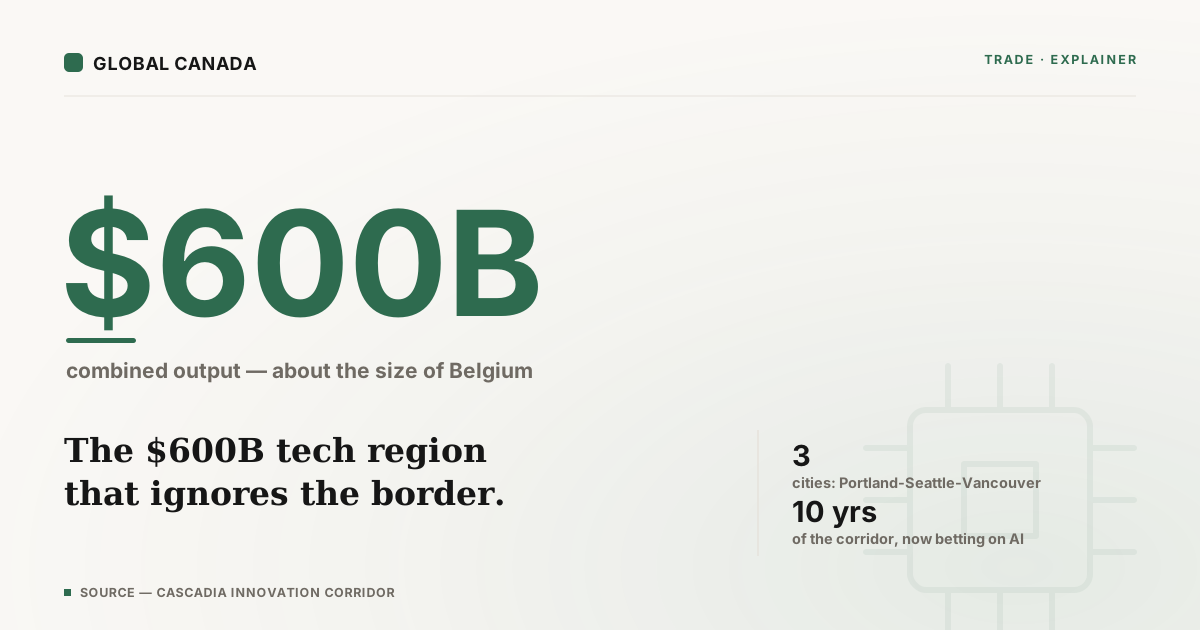
The Cascadia Innovation Corridor runs from Portland through Seattle to Vancouver. Its combined economic output is around 600 billion dollars, roughly the size of the entire economy of Belgium, and it contains an unusual concentration of what the next decade will run on: world-class research universities, some of the planet’s largest technology companies, deep pools of AI and quantum talent, semiconductor capacity, and cheap clean power to feed the data centres. It is one of the most integrated cross-border economic regions anywhere, and it did not happen by treaty. It happened because the people in it decided the border was in the way and mostly chose to ignore it.
A region that predates the policy
Cross-border regions are usually the product of grand agreements signed in capital cities. Cascadia is closer to the opposite: an economic fact that governments have been scrambling to catch up with.
The gravitational pull is old. Vancouver and Seattle have traded talent and capital for decades; the software and aerospace giants of the American side have long recruited from British Columbia’s universities, and Canadian firms have long chased American markets and money. What the corridor’s boosters did, starting about ten years ago, was give the thing a name and an institution, an annual convening of business and civic leaders from Washington, Oregon and British Columbia, and start treating the integration as an asset to be cultivated rather than an accident to be tolerated.
Now, at its tenth anniversary, the corridor is placing a specific and timely bet. Its leaders are advancing a public-private partnership on artificial intelligence, on the logic that no single city in the region can lead in AI alone but the three together might. Vancouver’s research strength, Seattle’s corporate heft, the region’s clean energy and its computing infrastructure add up to something more than their parts, if, and it is a real if, the talent can keep moving freely among them.
The friction is the story
Which brings us to the one genuine obstacle, and it is worth dwelling on because it is so avoidable.
The thing slowing Cascadia down is not a shortage of ambition or capital or ideas. It is paperwork. The cross-border movement of skilled workers (the engineer offered a job on the other side, the founder who needs to build a team spanning both countries) runs into a United States immigration and visa system that has not kept pace with how the corridor actually operates. A region built on the frictionless flow of talent keeps hitting a border that, for people if not for ideas, has quietly gotten thicker.
This is the irony at the heart of the story. Capital crosses easily. Research collaborations cross easily. Data crosses at the speed of light. It is the humans who get stuck, the one input a knowledge economy cannot do without. Every founder in Cascadia has a version of the same complaint: the visa, not the market, is the ceiling.
Why it belongs in the good-news column anyway
Set that caveat in proportion, though. The remarkable thing about Cascadia is not the visa friction; it is that a 600-billion-dollar binational economy exists at all, thriving, in the same year the two national governments are trading tariff threats. The corridor is a standing demonstration that when you let two societies integrate at the level of universities, firms and people, they build something neither could build alone, and that the integration has a logic of its own, largely indifferent to the mood in Ottawa and Washington.
It is also a glimpse of where the relationship is strongest: not in the commodities and treaties that dominate the headlines, but in the softer, harder-to-tariff stuff: research, talent, ideas, the ambient trust that lets a Vancouver engineer take a Seattle job without thinking twice. Fix the visa problem and Cascadia could be one of the world’s premier AI regions. Leave it unfixed and the corridor will still be there, still humming, still quietly proving that the most valuable border on the continent is also, in the ways that matter most, the easiest to cross.