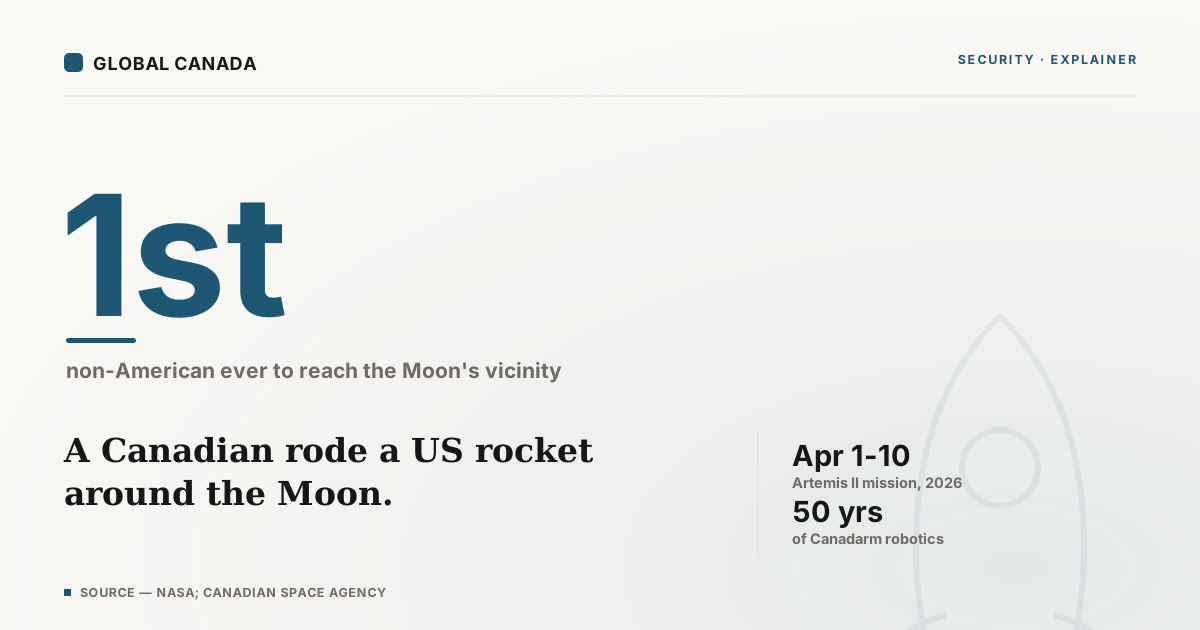
At 6:35 in the evening on the first of April, an orange rocket the height of a skyscraper lifted off from the Florida coast, and somewhere inside it a colonel in the Royal Canadian Air Force named Jeremy Hansen went along for the ride. Six days later he was on the far side of the Moon. On the tenth he was bobbing in the Pacific. In between, a man who grew up on a farm in southwestern Ontario became the only human being who does not hold American citizenship ever to travel beyond low Earth orbit and into the neighbourhood of another world.
He never touched the surface. Artemis II was a shakedown cruise, a crewed loop around the Moon and back, the dress rehearsal before the landings. Hansen flew as a mission specialist alongside three NASA astronauts, Reid Wiseman, Victor Glover and Christina Koch. For NASA it was a milestone in a program decades in the making. For Canada it was something stranger and more revealing: proof that a middle power with no rockets of its own had bought a seat at the highest table in human exploration, and paid for it in a currency it happens to be very good at making.
The arm that bought the seat
Canada does not build launch vehicles. It does not have astronauts stacked ten deep or a spaceflight budget that would register in Houston. What it has, and has had for fifty years, is a knack for robotics.
The lineage is almost absurdly consistent. In 1981 the first Space Shuttle carried a Canadian-built robotic arm, the Canadarm, which over three decades deployed satellites and helped assemble structures in orbit until the shuttle fleet retired. Its successor, Canadarm2, has been bolted to the International Space Station since 2001, where it catches visiting cargo ships out of the vacuum and walks itself hand-over-hand across the hull. The machines became so identified with the country that one of them is on the five-dollar bill.
The seat on Artemis II is the third act. In exchange for a place in the Artemis program, Canada committed to build Canadarm3 (a smart, largely autonomous robotic system) for the Gateway, the small space station the United States and its partners intend to park in orbit around the Moon. No arm, no astronaut. The deal was struck years before Hansen’s launch, and it is the clearest illustration you will find of how Canada operates in an alliance where it will always be the smaller party: find the one thing you do better than almost anyone, make yourself indispensable at it, and trade it for a place you could never afford outright.
Why it matters more than it looks
It would be easy to file a Canadian on a NASA mission under national trivia, a flag on a shoulder patch, a nice morning for the space agency. That undersells it.
Space cooperation is one of the few arenas where the Canada–US relationship is not asymmetric in the usual demoralizing way. In trade, Canada sends more than three-quarters of its exports to a partner that needs it far less than it needs the partner. In defence, it shelters under an American umbrella it cannot replicate. But in orbit, Canada holds something the United States genuinely values and does not want to build itself. That changes the posture. It is the difference between being accommodated and being wanted.
It also runs on a timescale that the political weather cannot easily touch. The Artemis agreements were negotiated across different administrations in both capitals. Canadarm3 will be under construction, and Hansen’s successors will be training, long after the current tariff fight is a paragraph in a textbook. Space is where the two countries plan in decades, and decade-planning is a kind of trust that a bad news cycle does not undo.
There is a domestic payoff, too, and it is not sentimental. The contracts flow to Canadian firms, the Brampton-based space company that has built the Canadarm family chief among them, and to the supply chain and the graduate programs that feed it. A robotic-arm franchise sustained across half a century is an industrial policy that actually worked, quietly, while louder ones came and went.
The part worth being honest about
None of this makes Canada a space power in any serious sense. It is a specialist riding shotgun on someone else’s program, and the arrangement carries the specialist’s risk: if Washington reorders its priorities, cancels Gateway, or stretches the Artemis timeline (all of which have happened to big space projects before) Canada’s plans move with it and Canada has almost no say in the decision. Indispensability at one task is not the same as control over the mission.
And a single astronaut orbiting the Moon does not reweave a relationship fraying over trade. It is one thread. But it is a bright one, and it points at something true: strip away the noise from the two capitals and you find institutions and industries that have spent fifty years learning to build things together that neither would attempt alone.
Hansen is back in Canada now, out of quarantine, already folded into the planning for what comes next. He has seen the far side of the Moon, which almost no one has, and he got there because a country of forty million decided long ago to be very good at one specific thing and to trade it well. There are worse models for a middle power to follow.