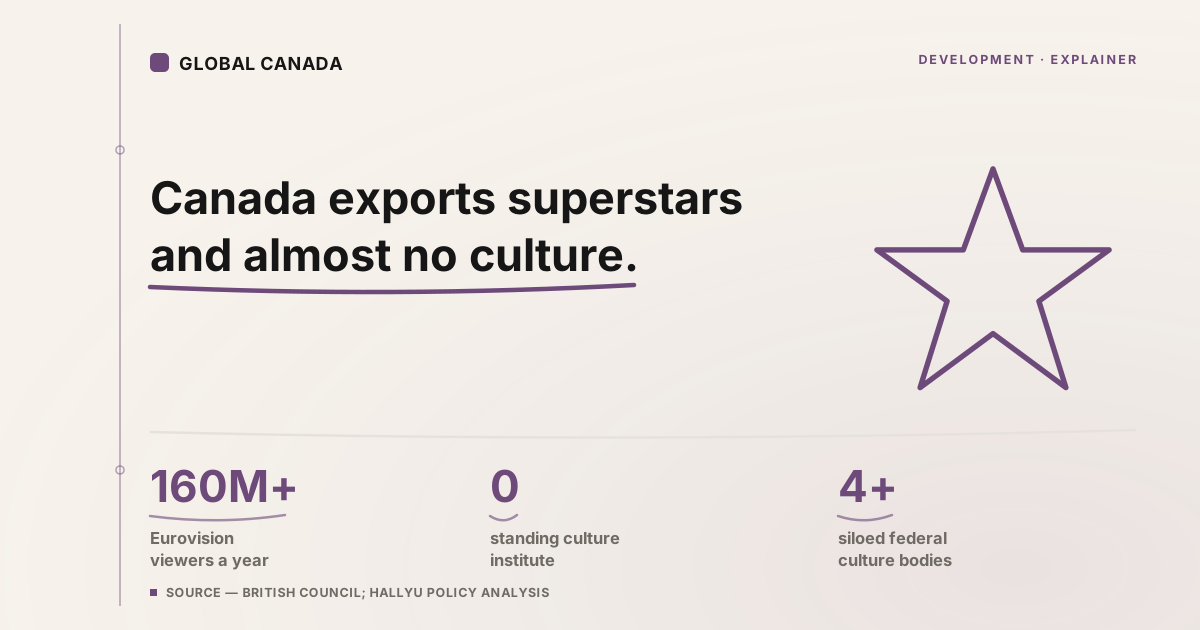
Every few years, a strange conversation flares up in Canadian media: should Canada join Eurovision? It cannot, of course. Eurovision is run by the European Broadcasting Union, and Canada is not in Europe. But the fact that the question keeps returning, usually alongside proposals for some Commonwealth-flavoured equivalent, is itself worth examining. It is the sound of a country noticing a gap it cannot quite name: Canada produces world-class culture and has almost no idea how to turn it into national influence.
Eurovision is a useful entry point precisely because of what it is, the world’s largest live music broadcast, north of 160 million viewers a year, and, for the nations that compete, an instrument of cultural diplomacy barely disguised as a singing contest. Ukraine’s 2022 victory was a global solidarity moment as much as a musical one. Countries use the stage to project a version of themselves to a continent. Canada watches from outside, and the watching has become a small national preoccupation.
The gap between production and brand
Here is the paradox. By almost any measure, Canada punches enormously above its weight in cultural production. Its musicians, novelists, filmmakers and television talent export at a per-capita rate that rivals Britain’s. And yet there is no coherent Canadian cultural brand abroad, nothing like the instantly legible national identities that smaller countries have built deliberately.
The reason is partly structural and slightly painful: Canadian artists tend to become global by ceasing to read as Canadian. They move south, or they get absorbed into a generic “international” category, and the association with Canada quietly evaporates. The country’s biggest cultural exports are frequently assumed to be American. Proximity to the largest cultural market on earth is a gift for individual careers and a curse for national branding.
What soft power actually takes
The comforting story Canadians tell is that cultural influence just happens, that talent rises and the flag rises with it. The evidence says otherwise. The cultural exports that read most clearly as national were engineered. Britain’s GREAT campaign, France’s “Creative France” export strategy, and above all South Korea’s Hallyu (the Korean Wave) all had deliberate government coordination behind what looked, from the outside, like organic phenomena. Korea did not stumble into becoming a cultural superpower; its Ministry of Culture, Sports and Tourism spent years and real money building the pipelines.
The institutional comparison is where Canada’s problem becomes concrete. Britain has the British Council, with a global network. France has the Alliance Française and the Institut français. Germany has the Goethe-Institut. These are standing institutions whose entire purpose is to project national culture abroad. Canada’s equivalent is weak, underfunded, and scattered across Telefilm Canada, the Canada Council for the Arts, Global Affairs cultural programs and a patchwork of provincial agencies, none of them designed to do what the British Council does, and none of them talking to the others as though brand were the point.
And the rulebook Canada does have was built for a vanished era. The CRTC’s Canadian-content regulations were designed for a broadcast world that streaming has largely dismantled. Rules that once ensured Canadian music got played on Canadian radio do relatively little in a world where audiences find culture through global platforms that owe Canada nothing.
Is it a failure or just geography?
The honest answer is that it may be some of both, and the distinction matters for what Canada should do about it. If the soft-power deficit is a policy failure (underinvestment, fragmentation, obsolete regulation) then it is fixable with money and coordination, an “AI CIDA” of the cultural world. If it is a structural constraint (the unavoidable price of sharing a continent and a language with the world’s cultural hegemon) then no amount of institution-building will fully close it, and Canada should aim for something more modest than a Goethe-Institut.
Canada has never really decided which it believes, which is why the debate keeps surfacing as a question about a European song contest the country cannot enter. Eurovision is not the issue. It is the mirror. And what it keeps reflecting is a country that makes more culture than it knows what to do with, and has never built the machinery to make any of it count.
Reading list
- British Council annual report; Alliance Française network overview
- Korean Wave (Hallyu) policy analysis, ROK Ministry of Culture, Sports and Tourism
- Canada Council for the Arts: international cultural exchange programs
- CRTC Canadian-content and streaming regulation reviews (2023–2025)
- History of Eurovision participation and broadcasting rights