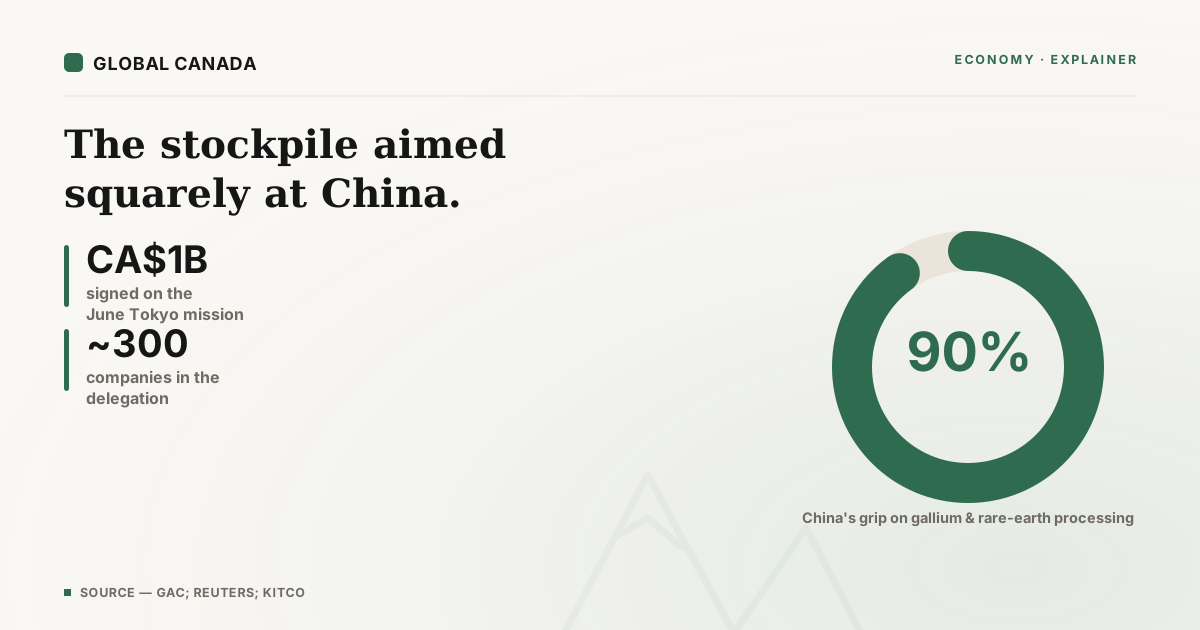
When Beijing wants to remind the world of its leverage, it does not fire a shot. It restricts an export. In recent years the target has often been gallium and germanium, obscure metals most people have never heard of, essential to the semiconductors, radar and night-vision systems that modern militaries run on, and produced overwhelmingly in China. A quiet tightening of Chinese export licences can send buyers around the world scrambling. That scramble is the reason a Canadian trade minister landed in Tokyo this June with three hundred companies behind him.
The Team Canada trade mission that Maninder Sidhu led to Japan in June 2026 was the largest Canada has ever sent to the Asia-Pacific, roughly 300 representatives from some 180 organizations, and it came home with more than a billion Canadian dollars in signed commercial agreements. But the number that mattered most was not the dollar figure. It was the idea the two governments began seriously discussing: pooling their strategic mineral reserves.
What “shared stockpiling” would actually mean
Countries hold stockpiles of critical materials the way they hold strategic petroleum reserves, a buffer against a supply shock. What Canada and Japan are exploring is stranger and more intimate: holding some of those reserves jointly, so that each could draw on a shared pool during a shortage.
For two market economies, that is an unusual degree of coordination. It treats supply security as a common good rather than a national one, and it only makes sense between countries that trust each other quite deeply, because a stockpile you might have to share is a stockpile you have partly surrendered control of. The materials in question are the ones where Chinese dominance is most acute: graphite, gallium, germanium and the rare-earth elements, across both mining and the processing that turns raw ore into usable material.
Alongside the stockpiling idea sit more conventional tools: joint mining projects, and offtake agreements in which a buyer guarantees to purchase a producer’s future output, giving a mine the certainty it needs to raise money and get built. Canada has the deposits and the mining expertise; Japan has the capital, the processing technology and the demand. The fit is close to ideal.
A pact with the paint still wet
It would be easy to oversell this. The arrangement is, for now, a non-binding memorandum of cooperation, a statement of direction and a framework for private-sector matchmaking, not a treaty that obliges either government to do anything. No mineral has yet moved because of it that would not have moved anyway. The billion dollars in agreements is real, but “mobilized” and “signed” are not the same as “mined” and “processed.”
This is the recurring gap in critical-minerals diplomacy everywhere: the announcements travel at the speed of a press release, and the mines travel at the speed of a decade. A new mine can take more than ten years from discovery to production, and the refining capacity that actually breaks Chinese dominance is even harder to stand up. A memorandum signed in Tokyo in 2026 will be judged by whether there is a working supply chain in 2036.
There is also a revealing wrinkle that suggests both countries know the bilateral version is not enough on its own: Canada and Japan have been talking with France about the same problem, a hint that the real ambition is a multi-country effort to rewire mineral supply chains among democracies, rather than a two-country handshake.
Still, of all the ways two governments can respond to being squeezed on the same chokepoint, choosing to build a buffer together rather than compete for scarce supply is about the most constructive available. The stockpile may never be filled. But the willingness to contemplate sharing one tells you how seriously Ottawa and Tokyo now take the possibility that the materials of modern industry could, one day, simply stop arriving.