The summits get the cameras. The canola gets the tonnage. While Ottawa and Tokyo spent 2026 signing partnerships on defence and minerals, the largest and steadiest thing the two countries actually do together kept happening in the holds of bulk carriers crossing the Pacific: Canada feeds Japan. Quietly, unglamorously, by the shipload.
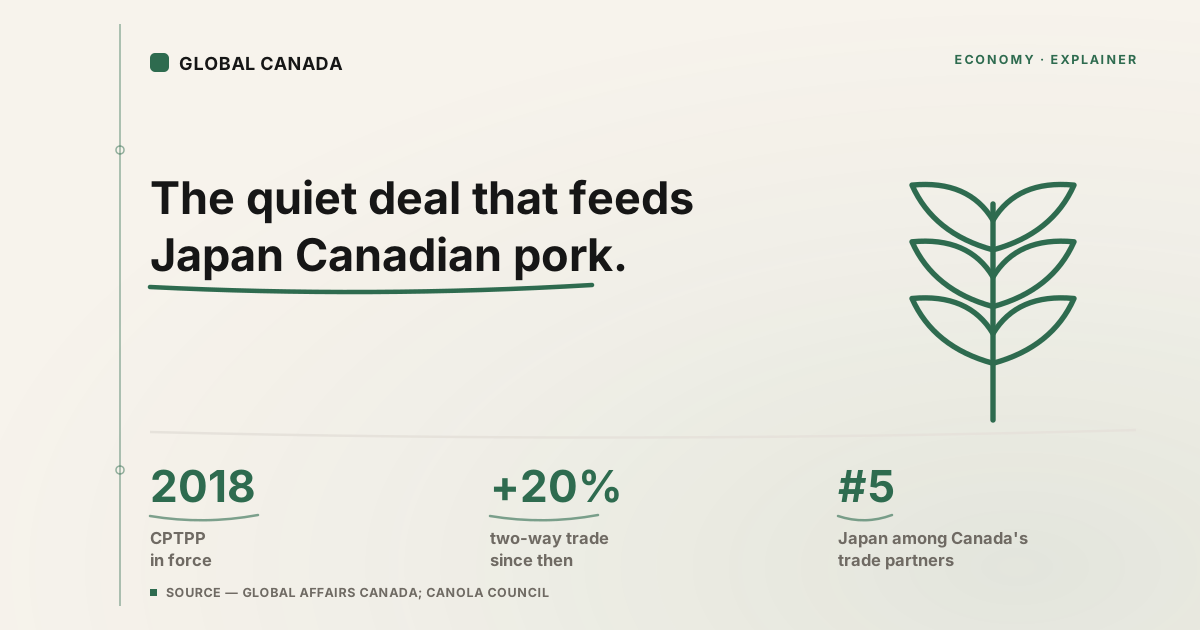
The instrument is not the new Comprehensive Strategic Partnership. It is a trade agreement that has been in force since 2018, the Comprehensive and Progressive Agreement for Trans-Pacific Partnership, the CPTPP, an acronym only a trade lawyer could love, wrapped around a deal that has reshaped what moves between the two economies. It eliminated or cut Japanese tariffs across a wide range of Canadian agricultural and seafood exports, and the effect showed up in the numbers: two-way merchandise trade has grown nearly 20 percent since it took effect, with agriculture doing much of the heavy lifting.
Why food is the ballast
Japan is one of the most food-import-dependent large economies on earth. It is a densely populated chain of mountainous islands with limited arable land, and it must buy much of what it eats from abroad. That makes the identity of its suppliers a quiet matter of national security, the same logic that governs its hunt for energy and minerals applies, just as forcefully, to calories.
Canada is close to a perfect supplier. It grows vastly more than it can eat, in a stable democracy, with a reputation for reliability and food safety that Japanese buyers prize. Canadian canola goes into Japanese cooking oil and animal feed. Canadian pork and beef fill supermarket cases. Canadian wheat, pulses and seafood round out the manifest. This is not a boutique trade; it is bulk, everyday sustenance, the least dramatic and most dependable strand of the entire relationship.
And that dependability is precisely the point. Summits can be undone by the next election. A grain contract renewed year after year, a supply chain a Japanese importer has trusted for a decade, those are the ties that actually bind, because they are woven into how ordinary life is fed on the other side of the ocean.
The strategic turn
What is new is that the two governments have started to talk about food the way they talk about gallium and gas. The Economic Security Dialogue launched under the strategic partnership frames supply-chain resilience broadly enough to include the food supply, not just minerals and semiconductors. When trade becomes an instrument of coercion, a reliable source of calories is a strategic asset, and both capitals have begun to treat it as one.
There is less drama here than in the minerals or defence files, and less to caveat. The trade is real, growing, mutually beneficial and already a decade deep. The main risk is not to the relationship but to the wider system that carries it: a serious trade war across the Pacific, or a shock to shipping, would land hard on a food supply chain both sides have quietly come to rely on.
For now, the canola keeps moving. It is worth remembering, amid all the talk of strategic hedging and diversified supply, that the most solid thing Canada and Japan share is also the most ordinary, the simple, durable fact that one country grows the food and the other eats it.