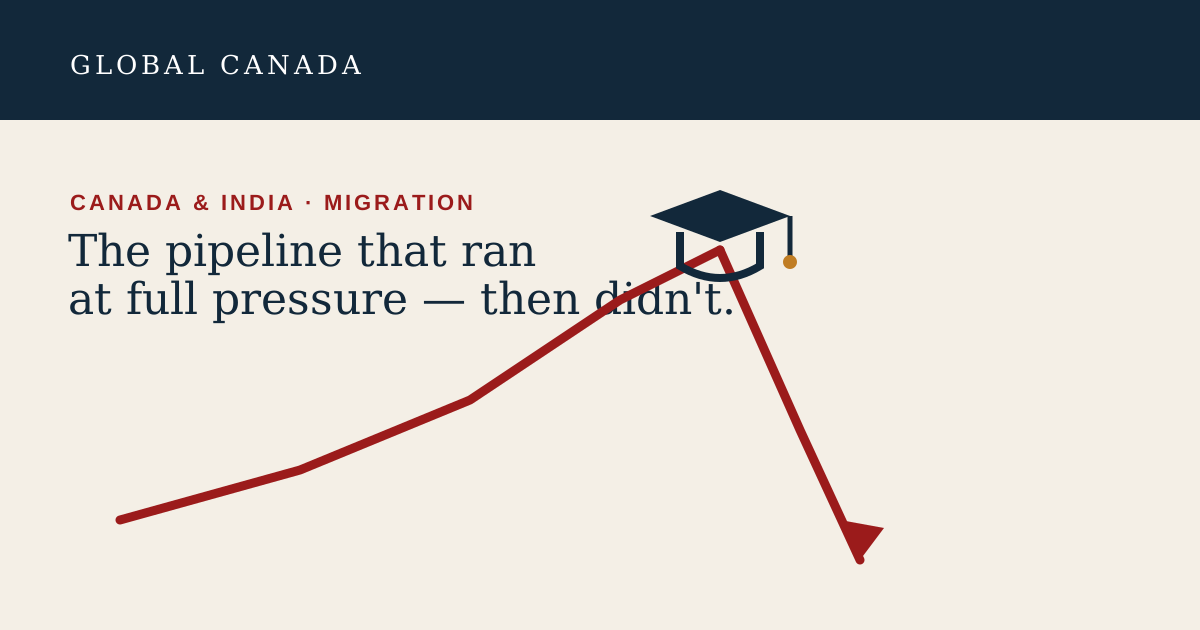
Drive through the outer suburbs of Toronto or the small cities of southern Ontario and you can still read the boom in the storefronts: the immigration consultancies, the money-transfer counters, the grocery shops stocked for a clientele from Punjab and Gujarat, the low-rise rentals subdivided one more time. Much of it went up on the back of a single fact: for the better part of a decade, no country sent Canada more students than India did.
At the peak, Indian nationals accounted for something close to two in five of all study permits Canada issued. They filled the seats of private colleges and public universities alike, but especially the fast-growing career colleges and the public-college partnerships that turned international tuition into a business model. International students pay several times what domestic ones do, and for institutions squeezed by flat provincial funding, an Indian student with a study permit was not just a learner. He was a balance sheet.
Then, in the space of two years, the model broke on two fronts at once.
The first was policy. In January 2024, faced with a housing crunch and a public mood turning sharply against record immigration, Ottawa capped the number of new study permits and tightened the rules around the private-college partnerships that had done the most to inflate the numbers. The cap was not aimed at India. But because India supplied the largest share of the flow, India absorbed the largest share of the cut. Approvals fell, refusals climbed, and the pipeline that had run at full pressure for a decade was throttled almost overnight.
The second was the diplomatic freeze. After Canada linked Indian government agents to the 2023 killing of a Canadian citizen in British Columbia, the machinery that processes the relationship (visas, consular services, the basic administrative plumbing) seized up for a period on the Indian side. For a would-be student weighing where to spend four years and a large chunk of a family’s savings, political risk suddenly entered a calculation that had been, for years, close to automatic. Australia, the United Kingdom and a wary United States were all within reach. Canada stopped being the obvious answer.
The effect landed first where the dependence was deepest. Career colleges that had built entire campuses around international enrollment cut programs and staff. Landlords who had counted on four students to a unit found the units emptying. Towns that had reorganized their economies around a stream of young arrivals discovered how quickly a stream can be turned down. What had looked like a permanent feature of the Canadian education economy turned out to be a policy setting, and policy settings change.
It would be easy to read this as a simple contraction, and in the near term it is one. But the deeper problem is what the boom concealed. A large part of the Indian student pipeline was never really about education; it was about migration, with a diploma as the down payment on a work permit and, eventually, permanent residence. Colleges knew it, students knew it, and Ottawa, for years, was content not to look too hard. The cap did not just cut numbers. It exposed how much of a bilateral relationship had been built on a channel that both governments preferred not to examine.
For India, the loss is smaller than for the Canadian towns that leaned on the flow. Its students have other destinations, and its labour market has more graduates than it can absorb regardless. For Canada, the reckoning is sharper: an entire tier of its post-secondary system had come to depend on a single country’s young people continuing to choose it, and that assumption is no longer safe.
The permits still get issued, just far fewer of them. In the consultancies along the arterial roads of Brampton and Surrey, the desks that once processed a conveyor belt of Canadian applications now spread the risk, a file for Melbourne, a file for Manchester, a file for Canada if the numbers still work. The pipeline is not closed. It is simply no longer taken for granted, on either end.