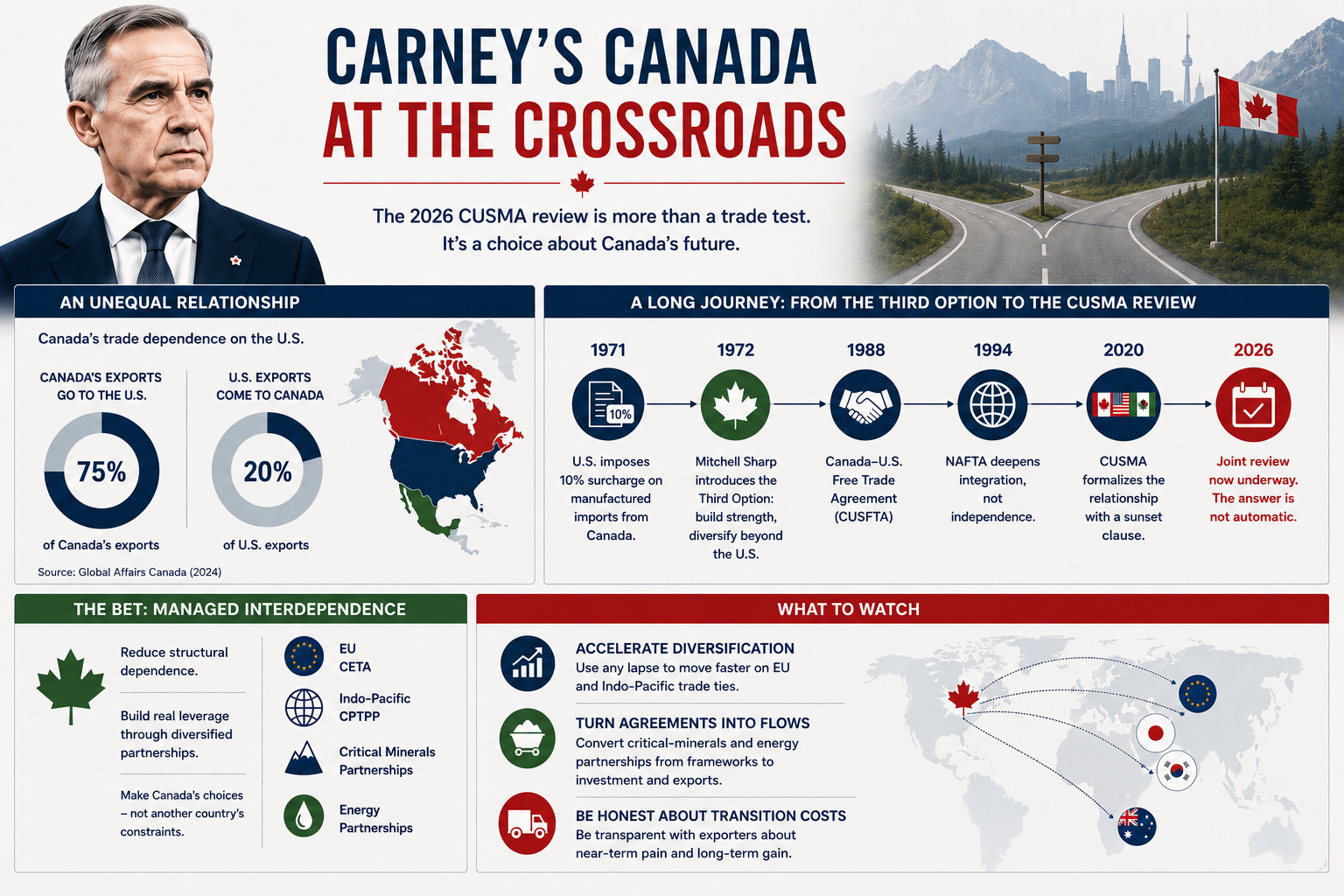
Canada turns 159 this week, and for the first time in many generations, the anniversary lands next to a genuinely open question about the country’s most important economic relationship. The CUSMA joint review (the mechanism built into the agreement to force Canada, the United States, and Mexico to affirm every six years whether the deal still serves them) is entering its final stretch this summer, and the noise coming out of Washington is no longer the routine grumbling about dairy quotas and softwood lumber. It now appears increasingly likely that the United States may simply decline to recertify the agreement on the terms Canada can accept, and let it drift toward the annual-review purgatory that precedes expiry rather than renew it for another sixteen years.
We don’t think that outcome is settled. We also don’t think Canadians should spend the summer hoping it doesn’t happen. They should spend it asking what it would actually mean if it did, because the honest answer is that it would confirm, more starkly than anything what Mark Carney has been saying for over a year now.
The relationship was never as equal as it looked
Nearly three-quarters of what Canada sells abroad goes to the United States. Only about a fifth of what the United States sells abroad comes back the other way. That asymmetry has been the defining feature of Canada–U.S. economic relations, and it did not begin with CUSMA or with Donald Trump’s talk of a “fifty-first state.” It goes back at least to August 1971, when the Nixon administration slapped a ten percent surcharge on manufactured imports (Canada included) without warning and without consultation, in violation of the trade rules of the day. Pierre Trudeau’s government was left asking what Canadian sovereignty was actually worth if a neighbour’s macroeconomic decision could be imposed without notice or recourse. Mitchell Sharp, then Secretary of State for External Affairs, answered with what became known as the Third Option: a deliberate policy of building up Canada’s own economic strength and international relationships so that dependence on Washington stopped being the whole of Canadian strategy.
Despite reaching the right diagnosis and option in 1972, Ottawa spent the next five decades abandoning it. The Canada–U.S. Free Trade Agreement in 1988 and NAFTA in 1994 moved the country in exactly the opposite direction (deeper integration, not diversified independence) and by the time Carney became Prime Minister, Canada was more economically exposed to a single trading partner than at any point in its history. CUSMA didn’t create that exposure. It formalized it, gave it rules, and gave it an expiry date. That was always the point of the sunset clause: to force the three governments to actually revisit the relationship rather than let it drift on autopilot. This year, for the first time, the clause is doing exactly the job it was designed to do, and the answer coming back is not automatically yes.
What Carney has actually been arguing
Many commentators describe Carney’s posture toward Washington as defiant. We think that undersells what he has actually proposed, which is more structural than rhetorical. He put it plainly: “Our old relationship with the United States, a relationship based on steadily increasing integration, is over… “Many of our former strengths, based on our close ties to America, have become weaknesses.”
Early on Carney realized that assumption of good-faith negotiation with current Administration was no longer given. That left diversification the only other viable option. The strategy assumes that Canada can build enough alternative economic relationships: CETA with the EU, CPTPP across the Pacific, bilateral critical-minerals agreements with Japan, South Korea, and Australia, that American market access stops being the kind of leverage it has been for fifty years. None of these agreements replaces the American market. That isn’t the point. But together they reduce Canada’s vulnerability.
Had Ottawa continued assuming durable American access, today’s review would look existential. Because diversification began earlier, it looks difficult rather than fatal.
The refusal is the point
Prime Minister Mark Carney’s most consequential decision so far may be a negative one: refusing to sign a bad deal simply to preserve the appearance of stability. Politically, it is an uncomfortable position to hold, because the costs of saying no are immediate and concentrated, in the auto sector, in agriculture, in every exporter watching this review anxiously, while the benefits of having said no are diffuse and only visible years later. It is much easier, politically, to take a worse deal today than to absorb the uncertainty of a lapsed one and bet on diversification paying off on schedule. That Carney has held the line so far, at real political cost, is the clearest evidence we have seen that the diversification agenda is meant seriously and not just as rhetorical cover.
There is a Canadian tradition behind that kind of strategic independence that predates Carney by generations. Lester B. Pearson helped build Canada’s postwar reputation not by reflexively aligning with Washington, but by demonstrating that Canada could be an independent and constructive ally. His leadership during the Suez Crisis showed that Canada’s influence often came from proposing workable solutions when larger powers were deadlocked. Later generations carried that tradition forward, from Canada’s leadership of the Ottawa Treaty to its role in advancing the doctrine of Responsibility to Protect.
Three tests
We don’t think Canadians should treat the CUSMA review as a countdown to catastrophe. They should treat it as the moment the country finally finds out whether the last two years of diversification talk produced anything durable. We need to watch three things over the coming months: whether Ottawa uses a lapsed or diminished CUSMA to accelerate (rather than merely announce) deeper trade ties with the EU and the Indo-Pacific; whether the critical-minerals and energy relationships being built with Japan, South Korea, and the Gulf states move from framework agreements to actual flows of capital and product; and whether the government is honest with exporters in the auto sector, in dairy, in softwood lumber, about the real transition costs of a more diversified trade posture, rather than pretending diversification is costless.
The picture could shift after the U.S. midterm elections in November. A divided government or a different congressional balance may create more political space for Ottawa in future negotiations. But the larger lesson is unlikely to change. Much of what is now described as “America First” (greater economic nationalism, industrial policy, strategic competition with China, and a more transactional approach to trade) has become embedded in the American political mainstream. The rhetoric may soften under a different administration or Congress, but the underlying direction of U.S. economic policy is unlikely to change.
None of that will be resolved this week, or this Canada Day. But 159 years after Confederation, the question facing Canada is no longer whether it can preserve the economic model that made it prosperous. It is whether it can build a strategy resilient enough to prosper in a world where its closest ally is no longer its most predictable partner.
Analysis drawn in part on research for the forthcoming book Without the Hegemon*, including its account of Canadian trade policy from the 1972 Third Option through the current diversification agenda. Figures on Canada–U.S. trade concentration and the CUSMA review mechanism are discussed further in Global Canada’s explainer, How CUSMA/USMCA Works.*