The last time a Canadian foreign minister landed in Islamabad on an official visit, the iPhone did not exist. Anita Anand ends that drought on July 20, nearly two decades on, and the symbolism is doing real work: Canada is courting a country of 250 million people it has largely ignored, as Ottawa deliberately widens its economic map across Asia.
Read the itinerary as a single sentence and the strategy is obvious. Anand meets Pakistan’s deputy prime minister and foreign minister, Ishaq Dar, and Prime Minister Shehbaz Sharif, then flies to Manila for the ASEAN Post Ministerial Conference on July 22 and the ASEAN Regional Forum on July 23. Two capitals, one purpose: broaden the range of places Canadian goods and Canadian workers can go.
The number behind the trip
In 2025, 71.7 per cent of Canada’s goods exports still went to the United States. That is the lowest share since the early 1980s, down 4.2 percentage points in a single year, and both facts are true at once: the dependence is loosening, and it remains overwhelming. Mark Carney’s government has attached a target to the drift. The 2025 federal budget committed to doubling exports of goods and services to non-US markets over the next decade, to $600 billion by 2035.
Getting there requires the arithmetic to move faster than sentiment. Canadian exports to countries other than the United States rose 17.2 per cent in 2025 to an all-time high, but much of that gain came from higher commodity prices and existing exporters selling more, not from new firms breaking into new markets. Diversification announced from a podium and diversification booked as an invoice are not yet the same thing, which is what makes the specific stops on this trip more interesting than the mission statement.
Pakistan: a small number growing fast
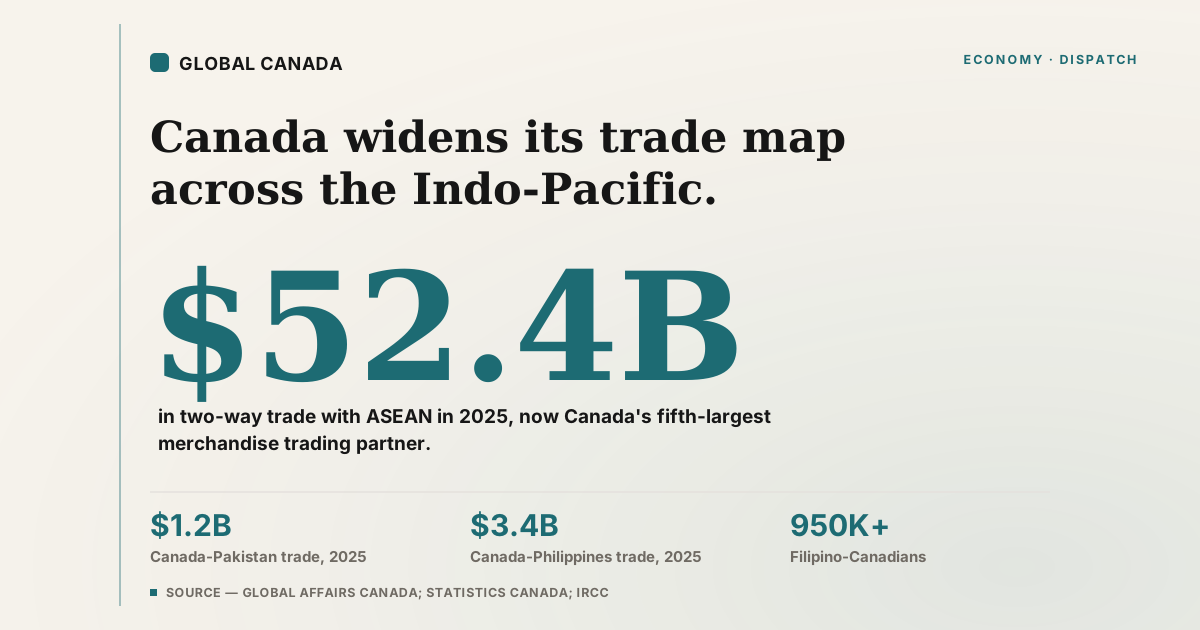
Canada-Pakistan trade is modest and lopsided, which is exactly why the trajectory matters more than the total. Two-way merchandise trade ran about $1.2 billion in 2025. Canadian exports were $499.7 million, up 65 per cent in a year; imports were $696 million. The single biggest reason for the jump is agricultural: canola-seed exports to Pakistan resumed in late 2025 and have already reached $426 million.
That last figure is the trip in miniature. Canola is the commodity China effectively closed its market to, and Pakistan is precisely the kind of large, food-importing economy that can absorb the volume a diversifying Canada needs to place somewhere. Ottawa hosted a second round of negotiations toward a foreign investment protection agreement with Pakistan in June 2026, the unglamorous legal plumbing that has to exist before capital follows canola.
The deeper connective tissue is people. More than 300,000 Canadians trace their origins to Pakistan, and roughly 20,000 Canadians live there. Those are the ties that keep a relationship warm through twenty years of ministerial neglect, and they are the reason a visit that produces no signed agreement can still count as groundwork.
The Philippines: the migration story Canada undersells
If Pakistan is the emerging line on the chart, the Philippines is the established one, and its real weight is not in the trade column. Canada-Philippines merchandise trade totalled $3.4 billion in 2025, but Canada runs a deficit there: $1.1 billion in exports against $2.3 billion in imports. The number that reframes the relationship is demographic. The Filipino-Canadian community now exceeds 950,000 people. In 2024 the Philippines sent 20,645 new permanent residents, second only to India, and it has been a top-three source country for years.
This is a labour relationship as much as a trade one. Filipino workers have staffed Canadian care homes and hospitals for four decades, a pipeline that began with the Live-In Caregiver Program of the 1980s; by 2021, 28 per cent of Filipino-Canadian women worked in health occupations, roughly double the rate for other women. When Canada talks about a strategic partnership with Manila, it is talking, in part, about the nurses and personal-support workers keeping its own aging population cared for.
The politics have moved to match. Carney welcomed President Ferdinand Marcos Jr. to Vancouver in early July 2026 to launch a Canada-Philippines Strategic Partnership covering trade, energy, defence and tourism, and a visiting-forces arrangement has given Canadian and Philippine militaries a legal basis to train together in a contested South China Sea. Development spending rounds out the picture: Canada’s international assistance to the Philippines was $87.9 million in 2024-25, part of more than $1 billion since 1986, directed at disaster resilience, food security and energy.
The multilateral frame
Neither bilateral track stands alone. Both hang off the Indo-Pacific Strategy Carney inherited from the previous government and has quietly kept funding, $2.3 billion committed since 2022. The ASEAN meetings in Manila are where that money buys a seat. As a bloc, the 11 ASEAN states were Canada’s fifth-largest merchandise trading partner in 2025, with $52.4 billion in two-way trade, and 2027 marks 50 years of Canada-ASEAN relations, an anniversary Ottawa plainly intends to arrive at with something to show.
The Regional Forum agenda is a reminder that trade and security travel together in this region. Anand is scheduled to raise Myanmar, tensions in the East and South China Seas, North Korea, Ukraine and the Strait of Hormuz. A country hunting for export markets in Southeast Asia cannot credibly show up only for the commerce and skip the maritime security that its prospective partners actually worry about.
What to watch
The test of this trip is not the communiqués. It is whether the specific deals move: whether the Pakistan investment-protection agreement gets signed, whether canola stays flowing, whether the Philippines partnership converts into labour-mobility and energy agreements with numbers attached rather than adjectives.
The structural problem sitting underneath all of it does not resolve in a week. Seventy-two cents of every export dollar still crosses one southern border, and closing that gap to hit $600 billion by 2035 requires new exporters, not just higher prices on the commodities Canada already ships. Anand can open the doors in Islamabad and Manila. Whether Canadian firms walk through them is the part no minister can announce.
Sources
- Trip itinerary and the Pakistan, Philippines, ASEAN and Indo-Pacific Strategy trade and assistance figures ($1.2B Canada-Pakistan trade; $499.7M exports, up 65%; canola $426M; $3.4B Canada-Philippines trade; ASEAN $52.4B and fifth-largest partner; IPS $2.3B): Global Affairs Canada
- U.S. share of Canadian goods exports (71.7% in 2025, lowest since the early 1980s): CBC News
- Non-U.S. export growth and the target to double non-U.S. exports to ~$600 billion by 2035: Global Affairs Canada, State of Trade 2026
- Philippines as Canada’s second-largest source of new permanent residents (20,645 in 2024): immigration.ca
- 950,000+ Filipino-Canadians; 28% of Filipino-Canadian women in health occupations: Statistics Canada
- Canada-Philippines Status of Visiting Forces Agreement (November 2, 2025): National Defence
Figures as of July 2026.