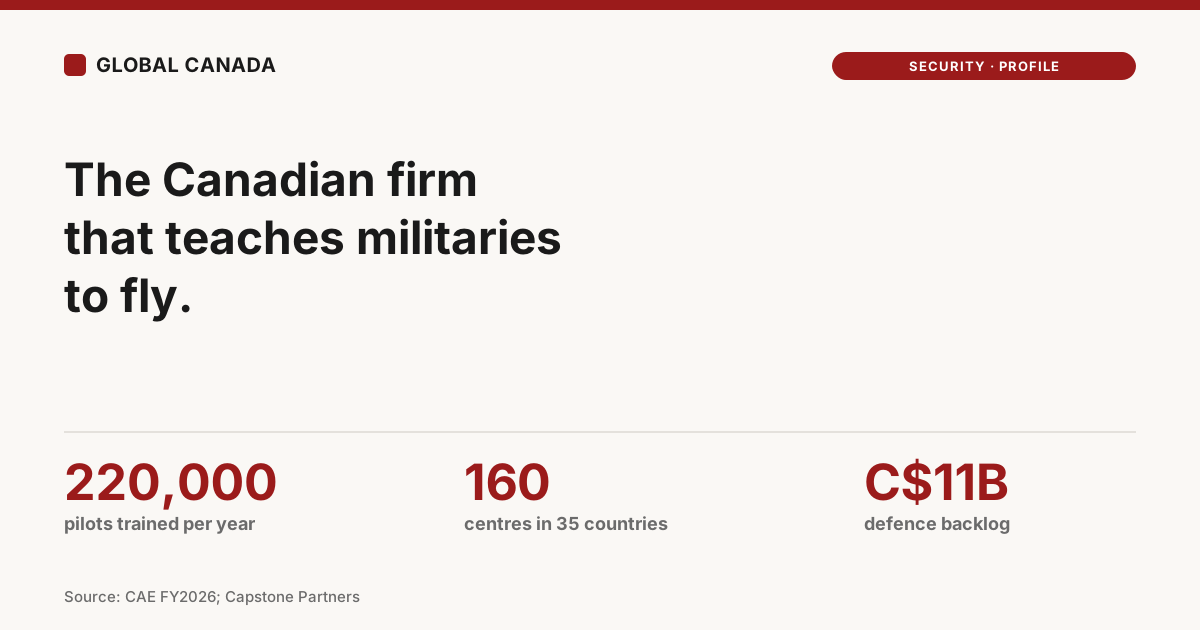
The box has no windows, rides on six hydraulic legs, and when the “aircraft” banks it pitches and drops hard enough to fool the inner ear. Inside, a pilot runs an engine failure on take-off, again and again, until the response becomes reflex. The machine was almost certainly built in Montreal. CAE makes the full-flight simulators that airlines and air forces train on, and it has quietly come to dominate the business: the world’s largest installed base of civil simulators, more than 360 full-flight machines across some 160 sites in 35 countries, and it trains more pilots than any other organization on Earth. Most of its work is invisible precisely because it happens before anything real leaves the ground.
CAE runs across three domains. Its civil-aviation arm trains commercial pilots on the world’s major aircraft types. Its defence-and-security business builds training systems and mission simulators for air, land, naval, space and cyber operations, serving the U.S. Army and Air Force and NATO allies. A smaller healthcare division makes medical simulators for surgical and emergency training, a segment that grew after the pandemic exposed how thin real-world training capacity could be.
Riding the defence surge
Defence is where the story is right now. Military spending across NATO has climbed to generational highs, Germany past 2 per cent of GDP, Canada’s own multi-year defence build running into the tens of billions, Poland and the United Kingdom ramping procurement, and every new fleet of aircraft needs pilots trained on it. CAE’s defence backlog runs beyond C$11 billion, which is another way of saying it can see years of demand before it has to win another contract.
There is a specifically Canadian dimension. Ottawa’s first Defence Industrial Strategy, released in 2025, singled out simulation and training as a domestic capability to be developed and protected, and CAE is the obvious anchor for it. The company already trains Canadian Armed Forces personnel, including for the incoming F-35A fighters and P-8A Poseidon patrol aircraft, which means the government’s own procurement feeds straight into its order book. Its earlier purchase of L3Harris’s military-training business gave it access to classified U.S. programs, a rare thing for a firm headquartered outside the United States.
A Canadian champion, quietly
For all its reach, CAE keeps a low profile at home, fitting for a company whose product is what happens before anything real takes off. Few firms of any nationality can train a commercial captain, a fighter pilot and a trauma surgeon under one roof; CAE does all three, and its position in civil aviation is close to unrivalled. That breadth is also its ballast: when commercial flying slumps, defence and healthcare carry the load; when defence surges, as now, the simulators and mission systems are ready. Anchored in Montreal and woven into the same aerospace supply chain as Bombardier and Pratt & Whitney Canada, it is exactly the kind of high-skill, export-heavy firm Canada’s industrial strategy keeps saying it wants more of. In a world rearming and re-equipping at once, the training house stays busy, and this one is Canadian.
Reading list
- CAE quarterly results and defence-backlog disclosures (fiscal 2026)
- Canada’s Defence Industrial Strategy (2025)
- Capstone Partners: training and simulation sector update (2026)
- DND Departmental Plan 2026–27