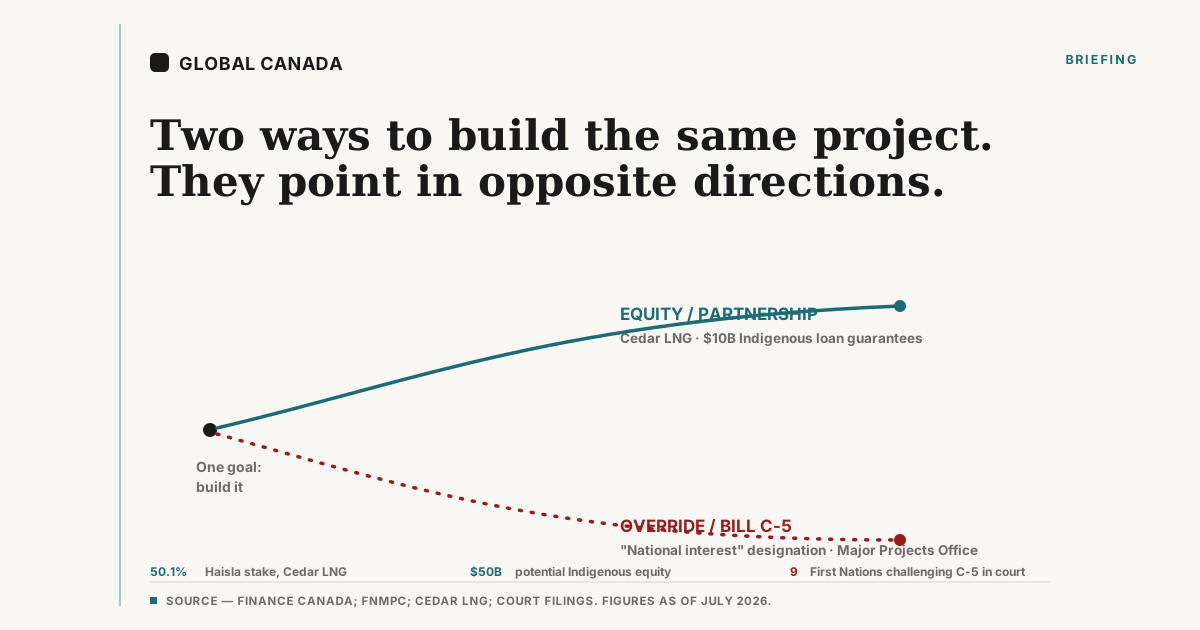
The date to watch is late 2028. That is when Cedar LNG, a floating export terminal being assembled in the Douglas Channel near Kitimat, is scheduled to ship its first cargo of liquefied natural gas. The terminal is still under construction and the timeline is a projection, not a ribbon already cut; first cargo could slip, as these projects do. What is fixed regardless of the schedule is the ownership. The Haisla Nation holds 50.1 per cent of Cedar LNG, having borrowed $1.4 billion from the First Nations Finance Authority, the largest loan that body has ever issued, to take majority control of a project on its own territory.
That structure, not the shipping date, is the point. This is the image Canada now shows the world of how it intends to build: the Indigenous nation not as a party to be consulted but as the controlling shareholder.
In the same stretch of months, nine First Nations in Ontario asked a court to strike down the law that lets Ottawa fast-track projects it deems to be in the national interest, and to enjoin the government from naming any such project at all. Two portraits of the same policy, taken the same year. One is a partnership. The other is a lawsuit.
Two instruments, two theories of consent
The first instrument is an equity architecture with real money behind it. In March 2025 the federal government doubled its Indigenous Loan Guarantee Program to $10 billion and opened it beyond oil and gas to transmission, transport and infrastructure, with individual guarantees running from $20 million to $1 billion. The early transactions are not symbolic. The program’s first guarantee, in May 2025, backed $400 million of a $736-million purchase by 38 British Columbia First Nations of a 12.5 per cent stake in a natural-gas pipeline system. By March 2026 two nations near Sarnia were taking a fifth of a provincial transmission line; by June, Ottawa announced its largest Indigenous guarantee yet against the new nuclear build at Darlington. The First Nations Major Projects Coalition, which now represents 186 nations, estimates that projects touching Indigenous land this decade could carry more than $525 billion in capital and as much as $50 billion in Indigenous equity. Indigenous groups already hold ownership across more than 5,000 kilometres of Canadian pipeline.
The theory beneath this is that consent and capital can be made to travel together. Give a nation a controlling or blocking stake, and its interest in seeing the project succeed becomes structural rather than negotiated. It is, in the government’s telling, reconciliation and supply-chain security solved by the same cheque.
The second instrument assumes the first will not always work. Bill C-5, the One Canadian Economy Act, received royal assent on June 26, 2025. Its Building Canada Act lets cabinet designate projects “in the national interest” and grant them federal approvals ahead of the ordinary sequence of reviews, coordinated through a new Major Projects Office meant to be a single front door for proponents. By mid-2026 the government had referred sixteen projects and seven “transformative strategies” to that office and moved to designate its first three: the Grays Bay road and port in Nunavut, the Mackenzie Valley highway, and a deep geological repository for nuclear waste in Ontario. The premise is that some projects matter enough to national and economic security that the state should be able to compress the timeline.
These two instruments encode opposite theories of what consent is. The equity model treats consent as a partnership to be bought into. The fast-track model treats it as a step that can, when necessary, be sequenced around. A government confident in the first would not need the second.
Why ownership is not the same as consent
The quiet flaw in the equity strategy is that it scales capital, not consent. Making the Haisla majority owners of Cedar LNG aligns incentives on Haisla territory, for that project. It does nothing to secure the agreement of a different nation on a different watershed, and it does not bind the nations that decline. The nine applicants in the Ontario challenge, among them Attawapiskat, Aroland and Kitchenuhmaykoosib Inninuwug, are not holding out for a better equity offer. Their claim is that C-5 and Ontario’s companion Bill 5 violate the Crown’s constitutional obligation to act honourably and the rights protected under section 35, and one of their leaders put the shift plainly to reporters: since these laws passed, “it’s no longer about Indigenous consultation, it’s about consent.” Canada legislated the United Nations Declaration on the Rights of Indigenous Peoples into federal law in 2021, with its standard of free, prior and informed consent. C-5 now tests what that standard is worth when a project is labelled national. Whether the Act ultimately permits projects to proceed in ways inconsistent with section 35 rights remains precisely what the courts are now being asked to determine.
This is where the equity architecture and the override law work against each other rather than in tandem. Every loan guarantee that turns a nation into an owner strengthens the expectation that development proceeds by agreement. Every national-interest designation that advances over a nation’s objection signals that agreement is optional. The Assembly of First Nations, whose chiefs voted to oppose the C-5 reforms where they weaken environmental protection or sidestep rights, is not a fringe. It is the same constituency Ottawa is courting with the $10-billion cheque-book.
The stake for allies
None of this would command much international attention if Canada were not simultaneously marketing itself as the reliable, rules-respecting alternative in critical minerals and energy. That pitch is aimed at the United States, the European Union, Japan and South Korea, all of which are trying to reduce dependence on Chinese-controlled supply. Canada’s comparative advantage in that competition is not only geology. It is the claim to be a jurisdiction where a mine or a transmission line can be built cleanly, durably and without the reputational risk attached to extraction elsewhere.
That claim rests on consent more than on capital or ore. The binding constraint on a Canadian critical-minerals project is rarely the absence of financing or deposits; it is whether the affected nations are partners or plaintiffs. This is the analytical core that the current debate, conducted largely in the language of permitting speed, tends to miss. Fast-tracking a project past a nation’s objection does not remove the delay. It relocates it, from the regulatory process to the courts and, in the harder cases, to the land itself. A designation that produces an injunction or a blockade is slower than the consultation it was meant to bypass.
The evidence to date points in two directions at once, which is the honest reading. The equity deals are real, accelerating, and popular with the nations that sign them. The opposition is also real, organized, and now in front of a judge. Both can be true, and the contradiction is the story rather than a wrinkle in it.
What to watch, and over what horizon
In the immediate term, the Ontario injunction application is the first hard test. A court willing to restrain the naming of national-interest projects would puncture the premise of C-5 before the first designation is complete; a court that defers to Parliament would embolden the government to press ahead. Either way, the ruling will be read closely by proponents deciding whether a “national interest” stamp is an asset or a liability.
Over the next few years, the metric that matters is whether the equity model widens faster than the override model is used. If loan guarantees keep converting nations into owners and the fast-track power is reserved for genuinely uncontested infrastructure, the two instruments can coexist. If Ottawa reaches for designation on a contested mine or pipeline to prove the law has teeth, it risks the outcome it least wants: a marquee project frozen by litigation while allies watch Canada demonstrate that its consent regime is unsettled.
The longer question is whether Canada comes to treat consent-based partnership as its comparative advantage or as friction to be engineered away. A country that made Indigenous nations the owners of its export infrastructure would have something no competitor could easily copy.
Sources
- $10 billion Indigenous Loan Guarantee Program (doubled from $5 billion, March 2025): Bennett Jones; Canada Indigenous Loan Guarantee Corporation
- Haisla Nation’s $1.4 billion First Nations Finance Authority loan and 50.1% Cedar LNG ownership: BNN Bloomberg; Cedar LNG
- $525 billion in potential projects, up to $50 billion in Indigenous equity, 5,000+ km of pipeline under Indigenous ownership, 186 member nations: First Nations Major Projects Coalition via Canadian Mining Journal
- Largest Indigenous loan guarantee in Canadian history, for the Darlington New Nuclear Project (June 2026): Department of Finance Canada
- 16 projects and 7 transformative strategies referred to the Major Projects Office; first three (Grays Bay Road and Port, Mackenzie Valley Highway, NWMO Deep Geological Repository): One Canadian Economy (Canada.ca); CBC News
- Bill C-5 (One Canadian Economy Act) royal assent, June 26, 2025: Parliament of Canada
- Nine First Nations’ constitutional challenge to Bill C-5 and Ontario’s Bill 5: The Globe and Mail
Figures as of July 2026.