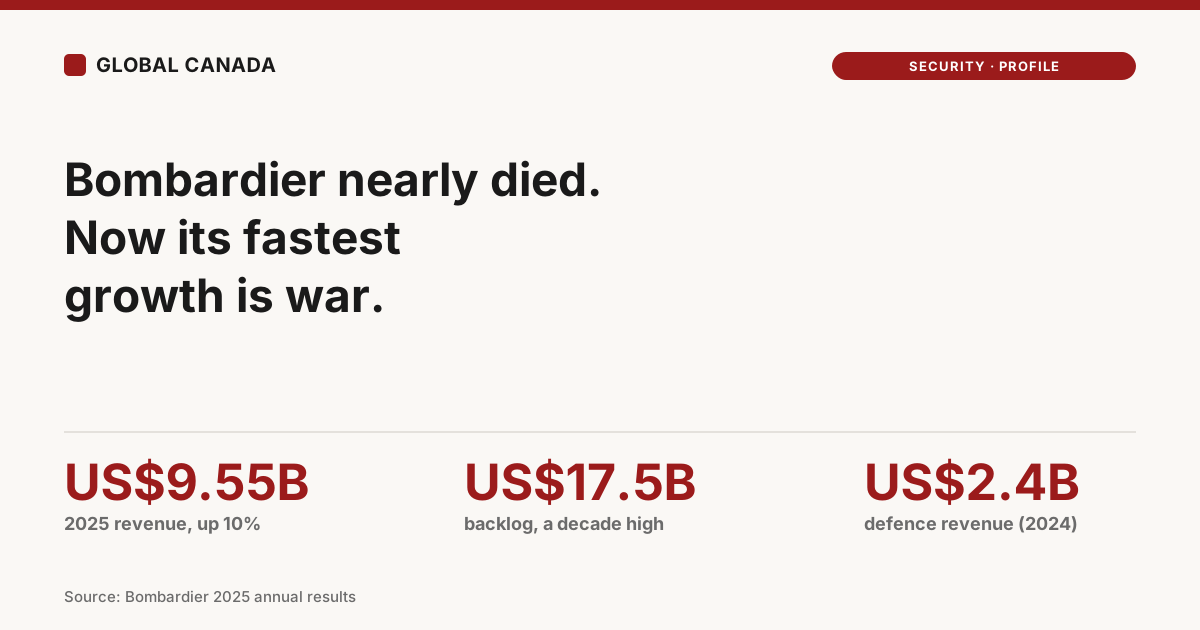
Bolt a radar the size of a canoe to the spine of an executive jet and you have changed what the aircraft is for. That, more or less, is the manoeuvre behind Bombardier’s revival. A decade ago the Montreal planemaker was a byword for corporate near-death, overextended and debt-laden, selling off its train and commercial-jet businesses to stay alive. It closed 2025 declaring the turnaround complete, and the ledger backs the claim: revenue of US$9.55 billion, up 10 per cent; adjusted EBITDA up 15 per cent to about US$1.56 billion; leverage cut from 2.9 times earnings to 1.9. It delivered 157 aircraft and ended the year with a US$17.5 billion backlog, up 22 per cent and its largest in a decade, after a single customer ordered 50 jets. Demand is now running ahead of what the factory can build.
That is the recovery story. The more interesting one is what is pulling it forward.
The defence pivot
Bombardier’s fastest-growing segment is defence: military-configured versions of its business jets, kitted out for intelligence, surveillance and reconnaissance, maritime patrol, command-and-control and head-of-state transport. In 2025 the defence unit passed US$1 billion in revenue, a target the company had set for 2030 and hit five years early. The logic is plain once you see it. A business jet adapted for a military mission can be bought and fielded far faster, and far more cheaply, than a purpose-built military aircraft, and as NATO members expand and re-equip, that speed is exactly what they are short of.
The clearest signal of where this leads came at the Paris Air Show in June 2025, when France declared its intent to buy Saab’s GlobalEye early-warning aircraft, a Swedish radar-and-mission suite mounted on a Bombardier Global 6500 airframe. By December the deal was firm: two aircraft, roughly US$1.3 billion, with deliveries running from 2029 to 2032 and an option for two more. A Canadian airframe, Swedish sensors, a French buyer replacing an aging AWACS fleet, is a defence export of real weight, and a template for how Bombardier turns a civilian jet into a strategic asset.
The Quebec anchor
Strip the defence narrative away and Bombardier is still one of the load-bearing columns of Canadian industry. It accounts for roughly a quarter of the country’s aerospace manufacturing output. Quebec’s aircraft exports reached C$11.2 billion in 2024, close to a tenth of the province’s export value, and the company’s planned production over the second half of the decade is projected to add tens of billions to GDP and support tens of thousands of jobs a year. Its Montreal supply chain, Pratt & Whitney Canada, CAE, and hundreds of small and mid-sized machine shops, is among the most sophisticated manufacturing networks Canada has. When people talk about Canadian advanced manufacturing as something worth protecting, this cluster is a large part of what they mean.
The aircraft behind the business
Part of what makes the pivot work is the hardware. The flagship Global 7500 and 8000 have intercontinental range, enough to fly nonstop between almost any two points on the planet, which is what lets a business-jet platform take on missions that once demanded a bespoke military airframe. The same reach that carries an executive across an ocean carries a radar suite over one, loitering for hours off a contested coast. The Montreal firm that once built trains and regional jets for civilian life has found its most reliable growth in equipping allied air forces, a Canadian aerospace story with a long runway ahead.
Reading list
- Bombardier 2025 annual results (February 2026)
- FlightGlobal coverage of Bombardier’s defence unit
- Saab–France GlobalEye order (December 2025) and the Paris Air Show declaration (June 2025)
- Bombardier economic-footprint studies (2024–2029)