Ask a Canadian official twenty years ago what “Arctic policy” meant, and the answer would have been some blend of three things: Indigenous rights, environmental protection, and resource development. All three still matter. But somewhere after 2024, the file quietly changed character. Arctic policy is now inseparable from NORAD modernization, from NATO’s northern flank, from a legal dispute with the United States over the Northwest Passage, from Russia–China military cooperation in the high north, from the same critical-minerals competition reshaping Canadian trade, and, running under all of it, from a generational infrastructure deficit in Inuit communities that no amount of radar will fix.
A domestic file became a foreign-policy problem. What follows is how, and what Canada is spending to catch up.
The hardware
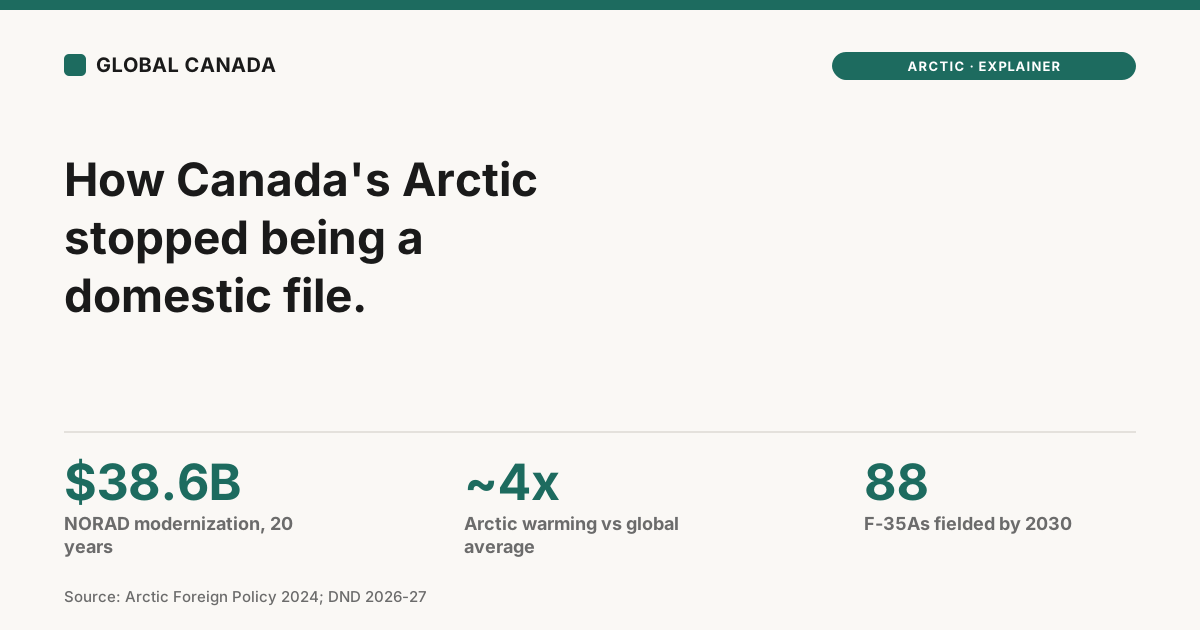
Start with the money going into steel and software. NORAD modernization is budgeted at $38.6 billion over twenty years: next-generation over-the-horizon radar to see threats coming across the pole, new Northern Operational Support Hubs, upgraded command-and-control. The Canadian Armed Forces have layered a set of northern operations on top: NANOOK-NUNALIVUT to sustain a presence along the Northwest Passage, LIMPID for all-domain surveillance, LATITUDE for maritime defence in the western Arctic, ARCTIC SENTRY tied to NATO.
The procurement list is the most concrete signal of intent. By 2030 Canada expects to field six Arctic and Offshore Patrol Ships, up to fifteen River-class destroyers, eighty-eight F-35As, eleven MQ-9B drones and sixteen P-8A Poseidon maritime-patrol aircraft. Whatever else one thinks of it, this is not a country treating the North as a museum of sovereignty symbolism. It is buying the ability to watch and, if it comes to it, to contest.
The minerals underneath
The reason the strategic temperature rose is partly geological. As sea ice retreats, the Arctic’s cobalt, lithium, rare earths and natural gas become physically more reachable, and Canada’s 2024 Arctic Foreign Policy did something earlier documents avoided: it explicitly tied Arctic sovereignty to critical-minerals development. Churchill, Manitoba, is being talked about again as a port and gateway for northern resource corridors. When the Prime Minister set out a northern plan in March 2026, the language was about developing “the critical minerals, clean energy, and trade corridors—the full economic potential—of the region.” Sovereignty, security and extraction have been fused into a single sentence. That fusion is the whole shift.
The people who live there
This is where the strategy gets harder, and more honest observers admit it. Inuit Tapiriit Kanatami, the national Inuit representative body, has warned that a rush toward military expansion risks crowding out the social conditions (housing, health, food security) that actually determine whether communities in the North can thrive. The 2009 Circumpolar Inuit Declaration on Sovereignty asserted, before any of the current buzz, that Inuit hold rights to self-determination that predate and underpin any state’s Arctic claim. The Carney plan puts 140,000 Northerners and Indigenous peoples at the centre of its vision. On paper, that is a phrase that does a lot of quiet work.
There are attempts to make the partnership more than rhetoric. Greenland Resources signed an MoU with Nuna Group Companies, an Inuit-majority Canadian construction firm, to build Indigenous benefit into a transnational mining deal. And there are frictions that show what happens when allied ambition meets local rights: Germany’s Luftwaffe wants to resume low-level F-35 training over Labrador, and Innu Nation Grand Chief Simon Pokue has opposed flights over Innu territory. The tension is not incidental to the Arctic strategy. It is the strategy’s recurring stress point: allied militaries, Canadian sovereignty, and Indigenous consent all pressing on the same ground.
The dispute Canada shares with its closest ally
Then there is the awkward matter of the Northwest Passage. Canada holds that the passage is internal Canadian waters, subject to Canadian law without exception. The United States insists it is an international strait, open to transit passage no single country may gate-keep. Both positions are decades old and legally serious. The reason the dispute is becoming urgent is the same reason everything else in the North is: the ice is thinning. The Arctic is warming at close to four times the global rate, the navigable season is lengthening, and shipping that was once theoretical is edging toward feasible.
Canada has not publicly defined its red lines on who may transit and under what conditions, which is a strange gap for a country asserting that these are its home waters. It is one thing to hold a sovereignty claim in the abstract. It is another to specify what you would actually do when a foreign vessel tests it, and Ottawa has not yet said.
That silence may be the truest measure of where Canada stands. The military spending is real, the procurement is under contract, the diplomacy with Greenland and NATO is active. But the country is still assembling the answer to a question the melting ice is asking faster than the strategy can reply: when the passage opens for real, who decides what moves through it, and is Canada ready to be the one who says no?
Reading list
- Canada’s Arctic Foreign Policy (2024); “Our North, Strong and Free” defence update
- DND Departmental Plan 2026–27; NORAD modernization backgrounders
- Prime Minister’s Arctic announcement (March 2026)
- Inuit Tapiriit Kanatami materials; 2009 Circumpolar Inuit Declaration on Sovereignty
- “Arctic Fever: Canada’s Ambitions in the North,” Open Canada (2026)